Two Easy Ways to Start Earning Rewards!
Earn 2X Pals Rewards points at Petco
when you use Petco Pay!
Get It Today
Owned and operated by fellow fish enthusiasts, Seachem has been providing hobbyists with education and support as well as trusted, scientifically proven saltwater and freshwater aquarium products for more than 40 years.
From Seachem Prime, the brand’s flagship water conditioner, to Seachem Stability, which helps prevent the number one cause of fish death, "new tank syndrome"—every product is backed by Seachem’s own staff of experienced chemists and biologists.
Petco proudly carries an extensive line of Seachem products, which are trusted by aquarists around the world to meet the needs of freshwater and saltwater aquariums, as well as reefs and ponds. Shop our wide selection of buffers, conditioners, filtration media, testing kits and more, many of which are completely unique and specific to Seachem:
Seachem Matrix is a unique, high-porosity biomedia for wet or wet/dry filters that have proven to be more effective than plastic biomaterials and will not break down or need to be replaced.
Seachem Purigen is a macro-porous synthetic polymer for freshwater and saltwater with the highest organic removal capacity among competing brands. Purigen darkens as it exhausts and can be easily renewed by treating it with bleach.
Developed for natural freshwater aquariums, Seachem Flourish contains a rich assortment of microelements, trace elements and other nutrients important to the health of aquatic plants.
Seachem products don’t just keep your aquarium healthy, they’re also designed to save you money through increased efficiency and concentration. Shop Petco’s Seachem solutions to find the best one for your aquarium today.
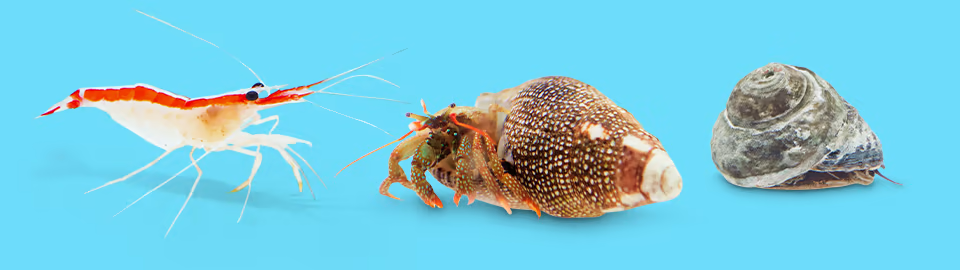
Visit Petco to learn about cleanup crews and how they can help your aquarium health.
Updated on October 29th, 2025
Learn how to test your aquarium water. Poor water quality stresses fish, which leaves them susceptible to disease and possibly death.
Updated on October 29th, 2025
Our top ten most important tips for removing and keeping algae out of your aquarium.
Updated on October 29th, 2025
Have cloudy water in your fish tank? In order to clear up your water, first you need to understand the potential causes to apply the correct solution.
Updated on October 29th, 2025
Do you have questions about brown algae (diatom)? Visit Petco and learn the causes, how to get rid of & how to prevent it.
Updated on October 29th, 2025
Check the water chemistry using a home test kit or submit a water sample for testing. The local Petco may do this for free or for a small fee. Aim for an absence (0 ppm) of ammonia and nitrites with nitrates at 20ppm or less. Perform partial water changes to stabilize chemistry and/or to improve water quality. Rinse the filter media in tank water, not tap water, and replace it. Use only conditioned water that is temperature matched to prevent stress or shock. To limit algae growth, maintain pristine water quality via filtration and regular water changes. If possible, turn up filter flow to keep water moving. If this stresses the fish though, do not do it. Do not overfeed and remove any uneaten food promptly. Limit lighting to 8 hours daily and closely monitor water temperature as well. All these can promote algae overgrowth.
Updated on August 12th, 2025
There are different ways to control algae accumulation inside the tank: Limit the nitrate accumulation in it (regular water changes is the most common method of removing nitrate), limit the lighting period in the aquarium (4 hours a day) avoid overfeeding. Try Algone, very effective against nitrate, it is not an algaecide but it can control indirectly algae. If all these methods are not effective, algaecide are then needed.
Updated on August 12th, 2025
Brown algae overgrowth can be due to high nitrates, too much light or overfeeding. Use a liquid home test kit or submit a water sample for testing. Most pet or fish stores will do this for free of for a small fee. If nitrates are over 40ppm, it can be decreased by performing partial water changes. Use only aged or conditioned water that is temperature matched to prevent stress or shock. You can also use a nitrate absorbing filter insert. The algae will need to be physically scrubbed from plants or rocks and can be scraped from glass. Rinse filter media using tank water NOT tap water. Limit light to 6 hours daily, 8 if you have live plants and do not over feed.
Updated on August 12th, 2025
Thanks for reaching out. Have you tested water quality for pH, ammonia, nitrite and nitrate. Correct problems. Don't see any signs of external lesion on the pictures, except fine erosion, and possible gravid fish. A veterinary visit is probably needed to trouble shoot for disease. Randomly adding chemicals to the water could have detrimental effects. Good luck.
Updated on August 12th, 2025
Some iron is necessary for a healthy aquarium, but too much can promote algae growth or impart an unsightly yellow or orange tinge to the water. Reverse osmosis (RO) filters are deal for removing mineral and heavy metals from water but they can be prohibitively expensive. Buying RO water from a local market or pet store is also a possibility but not economically feasible if you have a large tank. The best option may be a Polyfilter, which can be purchased in the local pet store or online. These filters will remove iron or other metals/chemicals and must be changed monthly or quarterly. You can also buy a water conditioner that will precipitate out some of the iron which can then be removed by mechanical filtration. An example of just one is Rid Metals (by Kordon). Follow label directions carefully, perform regular water changes and monitor iron levels with a home test kit or by submitting a water sample for testing.
Updated on August 12th, 2025