Two Easy Ways to Start Earning Rewards!
Become a member today! Members-only pricing and offers, personalized care notifications, Vital Care points back on every purchase and more!
 Become a credit card member today!
Earn 2X Pals Rewards points at Petco
when you use Petco Pay!APPLY NOWLearn More About Petco Pay Benefits
Tetra Algaecides & Water Clarity


Related Articles & Questions
- New Pet
Aquarium Water Quality: Master Healthy Fish & Crystal Clear Tanks
Learn how to test your aquarium water. Poor water quality stresses fish, which leaves them susceptible to disease and possibly death.
Updated on November 13th, 2025
- New Pet
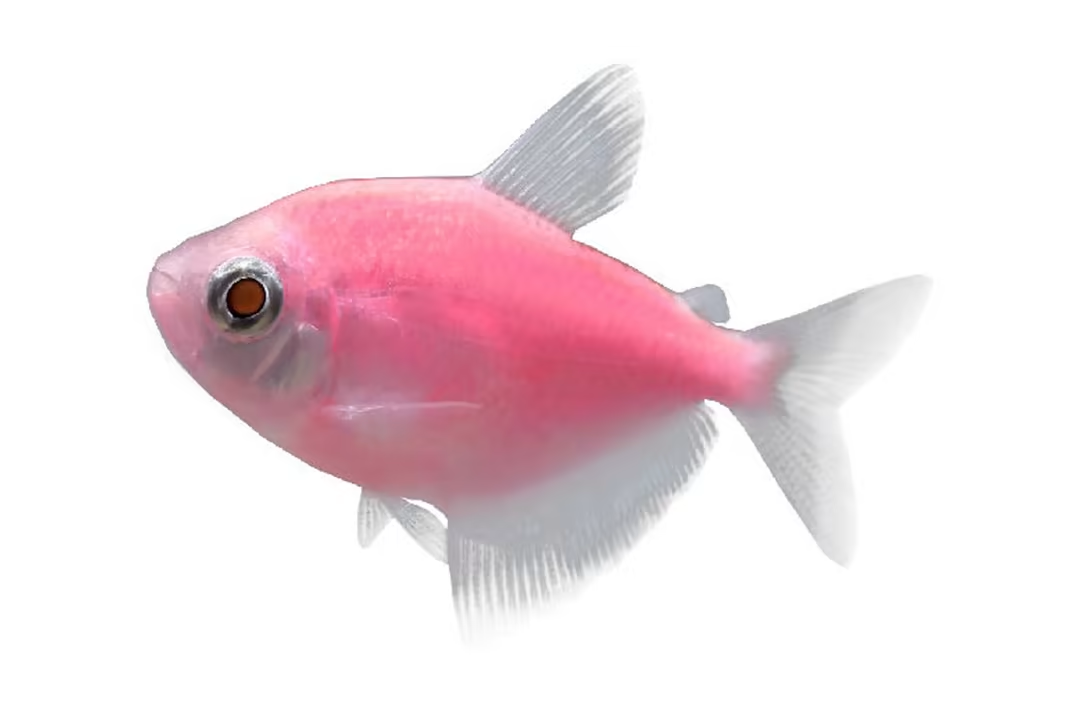
GloFish Care Guide: Tank, Food, & Compatibility for Thriving Fish
GloFish are brilliantly colored and beautiful fish. Learn how to care for GloFish, what to feed them, how long they live, their ideal tank size and more.
Updated on November 13th, 2025
- Home & Habitat
Aquarium CO2: Lush Plants, Vibrant Tanks & Thriving Aquatic Life
Wondering why you may need CO2 in your fish aquarium? Learn the basics from a Petco aquatics specialist.
Updated on November 13th, 2025
- New Pet
Don't Release Pets: Protect Waters from Invasive Fish & Plants
Habitattitiude™ commits to environmental protection by not releasing unwanted fish into public areas.
Updated on November 13th, 2025
- Health & Wellbeing
High Nitrates in Saltwater Tanks? Protect Your Fish & Water Quality
Learn about nitrates in your saltwater aquarium. Find out what is safe for your fish and how to improve your aquarium’s nitrate levels.
Updated on November 13th, 2025
- Health & Wellbeing
I'm about to buy some new fishes mostly Tetra Can you help me what fish should I buy because I am beginner in this things. Please tell me what sort of things I should bring I have a one foot tank now other than that What should I purchase from Aquar
Before you buy any fish, you will need to set up the tank. A basic set up includes: a tank, filter, hood/light, heater, gravel and some decor. The tank should run without fish for at least 4 to 6 weeks. This gives it time to cycle. The Nitrogen Cycle is critical to the health of the tank and any fish you will be keeping. During this time, beneficial bacterial will populate the filter and substrate (gravel). These bacteria will be responsible for breaking down fish wastes and other wastes (uneaten food, dead plants, etc.). You will need a home test kit to monitor water chemistry (ammonia, nitrites, nitrates, pH) or you will have to submit water samples for testing. Most pet stores will do this for free or for a small fee. At first, you will see high levels of ammonia and nitrites. Over time, as bacteria grow, these levels will drop. When ammonia and nitrites are at 0 ppm and nitrates are below 20 ppm, you can consider adding fish. Regular (every 1 or 2 weeks) partial water changes as we
Updated on August 12th, 2025
- Health & Wellbeing
Can I use Algecide for fish tanks in his tank? There is a lot of algae growth on the rocks and on the side of the tank. Is there any other advice to help me remove it?
There are different ways to control algae accumulation inside the tank: Limit the nitrate accumulation in it (regular water changes is the most common method of removing nitrate), limit the lighting period in the aquarium (4 hours a day) avoid overfeeding. Try Algone, very effective against nitrate, it is not an algaecide but it can control indirectly algae. If all these methods are not effective, algaecide are then needed.
Updated on August 12th, 2025
- Health & Wellbeing
hello i have started a 75 gallon tank last Saturday made 4 weeks i have had fish in the tank to help with cycling i had 8 zebra danio but they all have died or been eaten by the others now i have 6 black skirt tetras so i started putting fish in my t
If you put an Oscar in with your Tetras, they will be harassed and eventually eaten. Use a home test kit or submit a water sample for testing to check chemistry. Aim for 0 ppm ammonia and nitrites with a nitrate level of 20ppm or less. It can be slightly higher if you have live plants. If there is still ammonia present, the tank is still cycling. The cloudiness may be micro-bubbles which will eventually resolve or it could be a bacterial bloom which will also resolve once the tank has cycled.
Updated on August 12th, 2025
- Health & Wellbeing
We recently had two 5+ yr old plecos, 2 5+ yr old glofish, and a year old koi get cloudy eyes suddenly. 9 hrs later the plecos and koi died while 1 glofish died 2 days later and the other is alive, but not doing well. The plecos also had sunken eyes
Thanks for reaching out about Diesel. This surely points to water quality issues. Have you tested the ammonia, nitrites and nitrates? Any chance of copper in the system? Parasites and bacteria rarely cause death this quickly. Remove all fish and place in new tanks, with spring water (bottled or reverse osmosis). Change or add carbon filtration. Good luck.
Updated on August 12th, 2025
- Health & Wellbeing
My koi are loosing scales and one of my goldfish has white bumps on it's head. What could it be?
This could be bacterial or parasitic infection. It is difficult to determine definitively since the image provided is not clear. Fish can be difficult to photograph. Basic care includes checking water quality and chemistry. This can be done using a home test kit or by submitting a water sample for testing. The local Petco may do this for free or for a small fee. There should be an absence of ammonia and nitrites with nitrates at 20-60 ppm. pH should be as close to 7 as possible, avoiding large swings. Koi can tolerate a wide range in temperature, but generally do best between 65 F and 75 F. Again, avoid large swings in temperature to prevent stress or shock. If necessary, a partial water change can be done to stabilize chemistry and/or improve water quality. If you have other koi, consider placing this one in a hospital tank to make treatment easier and to prevent spread if the condition is infectious. Plain aquarium salt (NOT table or Epsom salt) can be used to reduce stress, impro
Updated on August 12th, 2025