Two Easy Ways to Start Earning Rewards!
Become a member today! Members-only pricing and offers, personalized care notifications, Vital Care points back on every purchase and more!
 Become a credit card member today!
Earn 2X Pals Rewards points at Petco
when you use Petco Pay!APPLY NOWLearn More About Petco Pay Benefits
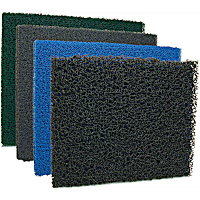
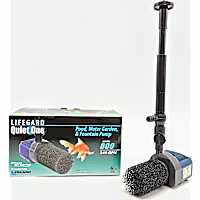
Lifegard Aquatics Pond Supplies


Related Articles & Questions
 Care Sheets
Master Aquatic Plant Care: Lush Aquarium Plants & Happy Fish
Tanks with live plants can be excellent additions to your home, bringing a touch of nature indoors. Learn how to take care of aquatic plants.
Updated on November 6th, 2025
- Care Sheets
Essential Large Marine Fish Care Guide: Tank Setup, Diet, & Tank Mates
Learn how to care for large marine fish, recommended diet and habitat setup. Find the right food, supplies and equipment at your neighborhood Petco.
Updated on April 9th, 2026
- Home & Habitat
How to Set Up a Fish Tank: Complete Setup Guide
Everything you need to know about how to start a fish tank. Learn about setting up an aquarium, choosing the right type, and acclimating new fish to your tank.
Updated on June 19th, 2026
- Food & Nutrition
What Do Small Fish Eat? Freshwater Feeding Guide
Feeding your freshwater fish isn't as simple as adding a pinch of flakes! Read these three tips to learn more about how to provide your pets the nutrition and environment they need.
Updated on July 17th, 2026
- Care Sheets
Goldfish Care Guide: Tank Size, Food, Water Quality for Thriving Fish
Learn how to care for Goldfish, recommended diet and aquarium setup. Find the right food, supplies and equipment at your neighborhood Petco.
Updated on April 9th, 2026
- Vet Q & A
First fish tank: What Tetras and supplies for my 12-inch tank?
Before you buy any fish, you will need to set up the tank. A basic set up includes: a tank, filter, hood/light, heater, gravel and some decor. The tank should run without fish for at least 4 to 6 weeks. This gives it time to cycle. The Nitrogen Cycle is critical to the health of the tank and any fish you will be keeping. During this time, beneficial bacterial will populate the filter and substrate (gravel). These bacteria will be responsible for breaking down fish wastes and other wastes (uneaten food, dead plants, etc.). You will need a home test kit to monitor water chemistry (ammonia, nitrites, nitrates, pH) or you will have to submit water samples for testing. Most pet stores will do this for free or for a small fee. At first, you will see high levels of ammonia and nitrites. Over time, as bacteria grow, these levels will drop. When ammonia and nitrites are at 0 ppm and nitrates are below 20 ppm, you can consider adding fish. Regular (every 1 or 2 weeks) partial water changes as well as filter changes will be needed to maintain stable water chemistry and adequate water quality. The size of your tank will determine what fish and how many you will be able to keep. Most Tetras do best in groups, so a 12 inch tank may not be large enough. There are several article in the Petco Pet Education Center, formerly Petcoach Library that will provide more detailed information. Click on "Educational Center" at the top of the page, then scroll down to "Articles" and click. Use the Search Bar to find articles regarding aquarium set up and fish keeping.
Updated on September 24th, 2025
- Training & Behavior
Moving fish long distance: How to transport and feed them safely?
Thanks for reaching out. If is a good idea to fast for 1-2 days prior to shipment, this decreased feces and will help to keep the ammonia down. Typically clear bags are utilized with about 50% water, and 50% air/oxygen used. A local pet store might be able to assist, as they get shipment in (so have older bags and boxes, which need to be disinfected) and hopefully the skills to ship. Check with the airline also, box needs to be well labelled "LIE ANIMALS" and "THIS END UP". Sometimes a health certificate for interstate travel is needed, so contact airline and State of Utah, veterinarian. Good luck.
Updated on September 24th, 2025
- Health & Wellness
My flower horn has ducklip, dark horn, and peeling skin. How to treat?
Maintain pristine water quality via filtration and daily partial water changes. That is the foundation for recovery. Drop the water temp gradually to about 75-76 F. The organism responsible for the infection thrives at temps in the low to mid 80s F. Use a broad spectrum antibiotic containing metronidazole. A Maracyn/Maracyn 2 combo may also help. Choose one treatment or the other. Find these products in the Aquarium section of the local pet store. Follow the label directions carefully and remove the carbon filter insert during treatment. Add an air stone or to to increase oxygenation.
Updated on September 24th, 2025
- Vet Q & A
Why do my fish keep dying in my newly set up aquarium?
It is possible the tank has not cycled properly which results in high ammonia and nitrite levels which can kill fish. Allow the tank to run, without fish, for at least 4-6 weeks. During this time, use a home test kit or submit a water sample for testing every few days. The local Petco may do this for free or for a small fee. What you are looking for is to have ammonia and nitrites at 0 ppm and nitrates at 20ppm or less. pH can hover around 7 for most community fish. Avoid large, rapid swings in pH though. What is happening in the tank during this time is that beneficial bacteria are populating the gravel/substrate and the filter. These bacterial populations are responsible for the Nitrogen Cycle. This cycle breaks down wastes from fish, uneaten food and plant matter into by-products that are filtered out or dissipate. You can "cycle" a tank with fish, however this increases the risk of loss. Once your tank has cycled, you can add fish. You will still need to monitor water chemistry and perform partial water changes regularly. Use only conditioned water that is temperature matched to prevent stress or shock. You will also need to vacuum the gravel regularly and rinse the filter media. Never use tap water to rinse. Use a bit of tank water to protect bacterial populations in the sponge.
Updated on September 24th, 2025
- Health & Wellness
Why are my goldfish sick with fin rot and not improving after water changes?
Hi, and thanks for your question. This is a quite concerning presentation and it is likely to be related to water quality. Begin by submitting a water sample for quality testing. Most pet stores will do this for free or a nominal fee. Clinical examination should always include a water quality check, even if you have done so already. Water testing should be performed with a quality test kit, measuring NH4, NO2 and NO3. High ammonia levels, PH imbalances may be responsible for these signs. Oxygen concentration and quality of the filters should be determined as well. If water quality is good and there are no major imbalances, your fish should get examined to look for any sign of bacterial/fungal infection and eventually water should be treated. Hope this answer was helpful, but please do not hesitate to contact us again on the forum or by requesting a consultation if you have any more questions or to discuss it any further. If this answer was helpful please let us know, this will be used to improve our service!
Updated on September 24th, 2025