Two Easy Ways to Start Earning Rewards!
Earn 2X Pals Rewards points at Petco
when you use Petco Pay!
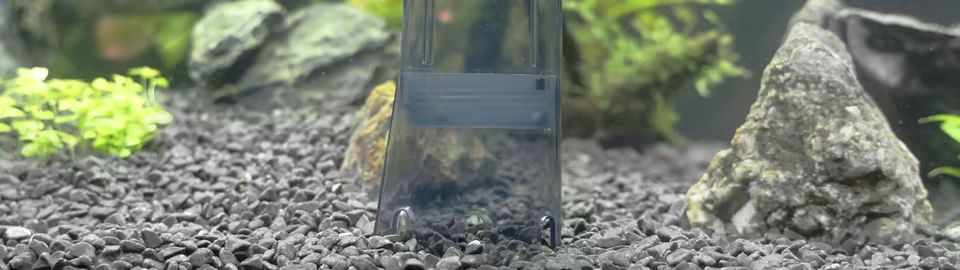
Gravel vacuuming helps remove solid waste from your substrate. Learn about the different types of gravel vacuums available & how to clean your fish tank.
Updated on November 13th, 2025
Learn more about Hygrophila care here at Petco. Hygrophila liven up any aquarium with proper care. Learn how to keep them happy & healthy.
Updated on November 13th, 2025
Feeding your freshwater fish isn't as simple as adding a pinch of flakes! Read these three tips to learn more about how to provide your pets the nutrition and environment they need.
Updated on November 13th, 2025
Although you may not realize it, aquaculture is something that touches our lives on a regular basis. Read more about what exactly aquaculture is, why it is important.
Updated on November 13th, 2025
It can seem a little scary at first, but having the proper equipment and preparation can help you care for your aquarium during a power outage.
Updated on November 13th, 2025
Thanks for reaching out about Corn and including photos. This could be mineral deposits but is difficult to tell in the photos. Mold usually does not grow below the water level as needs oxygen. Clean the filter well. A sample of the material can be acquired and a veterinarian might be able to help by examining under the microscope. Good luck.
Updated on August 12th, 2025
Hello, and thank you for using Boop by Petco. The most common (and easiest) way to clean a fish tank is with a siphon-style cleaner. Fish tanks should be cleaned in stages, generally replacing 10-15% of the water at a time. There are times where a larger cleaning might be necessary, but removing the fish and changing too much of the water at once can be quite a shock and can be dangerous to the fish, so this should be saved for only extenuating circumstances. Here's a helpful video on using a siphon cleaner: http://video.petco.com/v/18852/how-to-clean-your-aquarium-with-the-aqueon-siphon-vacuum-/ And some more reading you may find interesting on general fish tank cleaning and maintenance: http://www.firsttankguide.net/waterchange.php Hope this helps!
Updated on August 12th, 2025
I'm sorry you are having difficulties with your aquarium. There are several issues that should be dealt with right now. They are water chemistry, aquarium size and choice/number of fish. Any new aquarium should be set up and, ideally, run empty for several weeks (usually 4-6 weeks). This is so beneficial bacteria have an opportunity to populate the substrate and filter. These bacteria are necessary to break down wastes that fish will produce. The technical phrase for this is "establishing the Nitrogen cycle". These bacteria will break down wastes into ammonia then nitrites then nitrates. Nitrates can then dissipate or be absorbed/used by live plants. In high enough concentrations, ammonia and nitrites are toxic and can kill fish. Cycling a tank with fish is possible but it increases the risk of loss. Water chemistry should be checked every few days using a liquid home test kit. A water sample can be submitted for testing , but is not as convenient as testing yourself. Most pet sto
Updated on August 12th, 2025
Goldfish are surface breathers so seeing them up at the top is not unusual. They are also very dirty fish, so I recommend getting a small pump for aeration and doing a partial water change. There is usually a period of cloudy water after establishing a new fish tank until the bacterial balance is established and stabilized in the tank. I also recommend getting a siphon--type tank cleaner so you can use it to clean the gravel as you remove some of the water. It acts as a vacuum to pull out all the fish poo that settles to the bottom, and the water you remove from the tank is a great thing to water any plants you have with, as it also fertilizes them. Remove no more than half of the tank's water and replace it with clean fresh water that has had the correct amount of water conditioner for the volume you're adding.
Updated on August 12th, 2025
Check the water chemistry using a home test kit or submit a water sample for testing. The local Petco may do this for free or for a small fee. Aim for an absence (0 ppm) of ammonia and nitrites with nitrates at 20ppm or less. Perform partial water changes to stabilize chemistry and/or to improve water quality. Rinse the filter media in tank water, not tap water, and replace it. Use only conditioned water that is temperature matched to prevent stress or shock. To limit algae growth, maintain pristine water quality via filtration and regular water changes. If possible, turn up filter flow to keep water moving. If this stresses the fish though, do not do it. Do not overfeed and remove any uneaten food promptly. Limit lighting to 8 hours daily and closely monitor water temperature as well. All these can promote algae overgrowth.
Updated on August 12th, 2025