Two Easy Ways to Start Earning Rewards!
Become a member today! Members-only pricing and offers, personalized care notifications, Vital Care points back on every purchase and more!
 Become a credit card member today!
Earn 2X Pals Rewards points at Petco
when you use Petco Pay!APPLY NOWLearn More About Petco Pay Benefits
EcoBio-Block Fish


Related Articles & Questions
- Home & Habitat
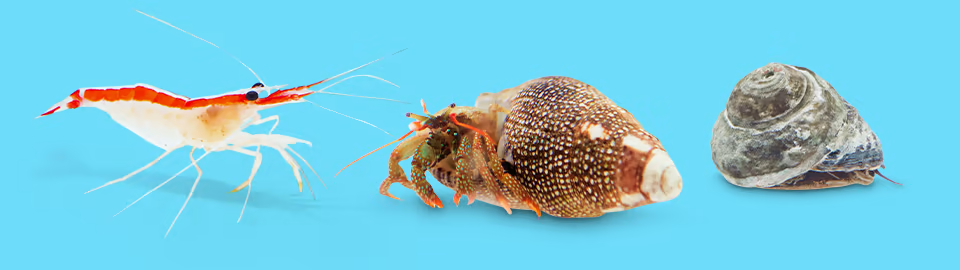
Saltwater Cleanup Crew: Banish Algae, Keep Your Tank Pristine
Visit Petco to learn about cleanup crews and how they can help your aquarium health.
Updated on November 13th, 2025
 New Pet
Aquatic Pet Owners: Stop Invasive Species, Save Our Waterways
Read about Habitattitude and Petco's commitment to protect our environment. At Petco, animals always come first. Learn how you can help.
Updated on November 13th, 2025
- Seasonal Topics
Aquaculture for Pet Fish: Essential for Healthy Tanks & Happy Pets
Although you may not realize it, aquaculture is something that touches our lives on a regular basis. Read more about what exactly aquaculture is, why it is important.
Updated on November 13th, 2025
- Health & Wellbeing
Revive Your Aquarium Plants: Fix Nutrient Deficiencies for Lush Growth
Are your aquarium plants nutrient deficient? Petco is here to help you identify different deficiencies such as light, nitrogen, co2, magnesium, iron and more.
Updated on November 13th, 2025
- Health & Wellbeing
Save Your Fish: Identify, Treat & Prevent Freshwater Ich (White Spot)
Ich or white spot disease is a common parasite in fish. Learn how to identify Ich and how to treat ich.
Updated on November 13th, 2025
- Health & Wellbeing
I have a small new 15 gallons tank. Can I add water and filter from my already cycled tank in the new tank for me to be able to add fish instantly?
Actually this is a good idea! I would however, make sure that the water temperature is the same as in the already running tank, so the good bacteria in the filter do not die. But , yes you can definitely do this without having to wait.
Updated on August 12th, 2025
- Health & Wellbeing
My fish has fin rot and seems lethargic. He will just sit at the bottom of his tank or in his flower. He might also have a swim bladder issue. What can I do to fix him?
Check the water chemistry and quality first. Poor quality can predispose him to infection. Use a home test kit or submit a water sample for testing. Your local Petco may do this for free or for a small fee. If ammonia and/or nitrite levels are elevated, perform partial water changes until both read 0 ppm and nitrates are 20 ppm or less. Use only conditioned water that is temperature matched to prevent further stress or shock. Providing pristine water quality is the foundation for treatment and healing. Check the water temperature since low temps can affect appetite and activity in fish. If the water is too warm, it can also affect activity since warm water does not hold as much oxygen as cooler waters. Fast the fish for 2-3 days then feed tiny bits of cooked and shelled green peas. This will aid in defecation if there is constipation. Plain aquarium salt (not table salt or Epsom salt) can be used for most fish as a general tonic to reduce stress, improve gill function, treat minor in
Updated on August 12th, 2025
- Health & Wellbeing
Hi I’m new in having fish, I got from a friend 9gold fish and 2 koi, a week ago I got 3 koi’s, they where totally fine but the las 2 days the 3 seemed away from the rest higher and looking towards a corner, one died today. And I’m asking for some adv
Check the water chemistry first. Use a home test kit or submit a water sample for testing. The local pet store or fish store may do this for free or for a small fee. Aim for an absence (0 ppm) of ammonia and nitrites with a nitrate level of 20 ppm or less. Perform partial water changes as needed to stabilize chemistry and/or to improve water quality. Use only conditioned water that is temperature matched to prevent stress or shock. These fish produce a larger than average bio-load (wastes), so strong filtration is a necessity. The filter should be rated for at least twice the volume of the tank. The size of the tank may also be an issue. When keeping koi, tanks or ponds in the hundreds (or even thousands) of gallons are common. The number of fish in the current tank is too high. Consider getting multiple tanks or a significantly larger tank. 9 goldfish would need at least a 100 gallon tank. The additional koi increases this number.
Updated on August 12th, 2025
- Health & Wellbeing
We have added fish to our newly set up aquarium twice now and both times the fish were dead or dying within 24 hours. The pH is at the proper level. The tank was filled with spring water. Why do our fish keep dying?
It is possible the tank has not cycled properly which results in high ammonia and nitrite levels which can kill fish. Allow the tank to run, without fish, for at least 4-6 weeks. During this time, use a home test kit or submit a water sample for testing every few days. The local Petco may do this for free or for a small fee. What you are looking for is to have ammonia and nitrites at 0 ppm and nitrates at 20ppm or less. pH can hover around 7 for most community fish. Avoid large, rapid swings in pH though. What is happening in the tank during this time is that beneficial bacteria are populating the gravel/substrate and the filter. These bacterial populations are responsible for the Nitrogen Cycle. This cycle breaks down wastes from fish, uneaten food and plant matter into by-products that are filtered out or dissipate. You can "cycle" a tank with fish, however this increases the risk of loss. Once your tank has cycled, you can add fish. You will still need to monitor water chemistry a
Updated on August 12th, 2025
- Health & Wellbeing
My new fish tank is being occupied by some white cotton web like thing at the bottom.. the are found on the natural plants and food remainings in the tank.. please help .. how to get rid of it? I tried changing the water 3 times..
Thanks for reaching out. This problem is perplexing, but possibilities include fungal or bacterial overgrowths. A good cleaning might help to alleviate your problems. Continue to test water quality and correct problems. Sometimes the over-growth of anaerobic bacteria (those which grow in low or no oxygen conditions, at the bottom of the tank), can form strange formations of detritus. Submitting a sample to a lab might help determine an answer. Good luck.
Updated on August 12th, 2025