


Two Easy Ways to Start Earning Rewards!
Become a member today! Members-only pricing and offers, personalized care notifications, Vital Care points back on every purchase and more!
 Become a credit card member today!
Earn 2X Pals Rewards points at Petco
when you use Petco Pay!APPLY NOWLearn More About Petco Pay Benefits
Petco Filters: Complete Aquarium Filtration Guide
Published on September 15th, 2023
Updated on June 18th, 2026


Reviewed by Don Spaeth
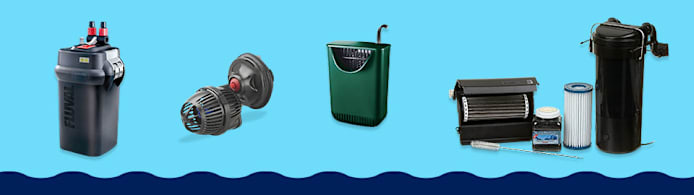
Discover the fish tank filter system that’s right for your aquarium. Learn about mechanical, chemical, and biological filtration at Petco.
Maintaining a successful aquarium comes down to a few key core components with one of the most vital being water quality. An aquarium filter is the life support system making the water safe for your finny friends by neutralizing or removing debris and impurities from the water.
There are numerous filter systems to choose from, each with their strengths and weaknesses. When trying to decide on the right filter for your aquarium you need to determine if the filter meets the mechanical, chemical, and biological filtration needs of your aquarium. As a general rule, the filter should turn over the total aquarium water 3 to 5 times every hour.
As implied the mechanical filtration portion is responsible for removing debris and particulates from the aquarium water. This typically takes place by pushing or pulling water through some type of fiber or foam material, separating the debris from the water.
The chemical portion of the filter utilizes some type of media, like activated carbon, to attract and adsorbs organics chemicals and compounds from the water.
Last but not least, one of the most important of the filtration processes is biological. Beneficial bacteria are responsible for breaking down toxic ammonia and nitrite into less toxic nitrate, making the water safe for your finny friends. Beneficial bacteria will grow on most surface areas in the aquarium but is best to offer an area, like a power filter, that will not be disturbed and provide an oxygen rich environment.
Types of aquarium filters
There are a lot of different filters available, so let’s explore some of the pros and cons of the more popular ones.
Sponge filter
Not just for cleaning, a sponge filter is just as the name implies. Sponge filters utilize an air pump or a powerhead to draw water through a foam sponge, trapping detritus and debris from the aquarium. The sponge offers a large surface area for beneficial bacteria to grow, making it a great biological filter. Sponge filters are great for smaller sized aquariums and utilized by fish breeders as they offer a gentle flow and do not pose harm to small fry like a power filter might. Because of their simplicity, they are also a good option for quarantine tanks.
A few drawbacks, sponge filters do not contain a chemical filtration component. They can be a little trickier to clean since you are unable to just rinse and clean these in the sink as that would kill off the beneficial bacteria. Sponge filters are best suited for smaller aquariums or ones containing low bio loads.
Recommended sponge filter
Box filter
The great grandfather and the first to the scene for home aquariums. Box, also known as corner filters, work similar to sponge filters. These are typically a plastic box that is operated with an air pump and air stone. Just like the sponge filter they are great for smaller, breeding or hospital tanks. The benefit of a corner filter over a sponge filter is the ability add various types of filter media, giving the benefit of the chemical filtration. Most are compact in design which will limit their ability to filter larger volumes of water.
Undergravel filter
Definitely not the new kid on the block, under gravel filters were the mainstream filter for years of aquarium keeping. Depending on the size of the aquarium, this filter consists of a single or multiple perforated plates that sits on the bottom of the aquarium, covered by substrate. A single or multiple tubes are connected to the plate and run by an air pump and air stone, or a powerhead. This draws water down through the substrate trapping debris and creating a large surface area for beneficial bacteria. Some offer carbon attachments, providing some chemical filtration.
A few cons with this type of filter, substrate needs to be adequate sizing. If too small this can block and plug the slits in the plate. If too large it will not trap the detritus appropriately. Detritus can build up over time causing increases in dead spots and nitrates. Beneficial bacteria require oxygen, this filter design can limit dissolved oxygen levels at the bottom of the tank thus limiting bacteria populations. Using a powerhead to operate it omits the chemical filtration option.
Recommended undergravel filters
External and Internal Power Filters
Power filters — also called hang-on-back (HOB) filters — are the most widely used filtration option for home fish tanks today. An internal power filter is a compact, submersible version of the same design, sized for smaller fish tanks. Both styles use an electrically driven motor and impeller to pull large volumes of water through filter media, delivering all three types of filtration in a single, straightforward unit.
What they do
- Mechanical filtration — a filter pad physically traps debris, uneaten food and waste particles as water passes through
- Chemical filtration — activated carbon inside the filter pad absorbs dissolved impurities, odors and discoloration
- Biological filtration — beneficial bacteria colonize the media and break down harmful ammonia and nitrite; some models include a bio-wheel that keeps those bacteria in constant contact with oxygen for even more efficient biological filtration
How they work day-to-day
Operation is straightforward: plug in the unit, hang it on the back of your fish tank (or submerge the internal version), and the motor does the rest. Routine maintenance is equally simple:
- Monthly — swap out the filter pad (the activated carbon inside becomes saturated and stops working effectively after about four weeks)
- Periodically — deep-clean the filter box and impeller to prevent buildup that can reduce flow rate or strain the motor
Pros and cons at a glance
| Feature | Hang-on-Back (HOB) Filter | Internal Power Filter |
|---|---|---|
| Best for | Most freshwater and marine fish tanks | Smaller fish tanks, quarantine setups |
| Filtration types | Mechanical, chemical, biological | Mechanical, chemical, biological |
| Ease of maintenance | High — media accessible from above | High — remove and rinse in tank water |
| Bio-wheel option | Available on select models | Rarely included |
| Footprint | Hangs behind the tank; tank cannot sit flush against a wall | Fully inside the tank; no rear clearance needed |
| Cost | Moderate to higher than sponge or undergravel filters | Generally lower than HOB |
| Failure risk | Low but possible — motorized components can wear over time | Same consideration applies |
A few things to keep in mind
Because power filters are motorized, there is a small risk of component failure over time — something worth factoring in when choosing a filter for a fish tank housing sensitive or high-value fish. The hang-on-back design also extends a few inches behind the tank, so plan for that clearance if your setup is against a wall.
On balance, the combination of reliable three-stage filtration, ease of use and wide availability of replacement media makes power filters a strong choice for most pet parents — from beginners setting up their first aquarium substrate and gravel bed to experienced aquarists managing a larger community tank. The added cost over simpler filter types is generally well justified by the performance and convenience you get in return.
-
Aqueon QuietFlow LED PRO 10 Aquarium Power Filter
-
Aqueon X-Small QuietFlow E Internal Power Filter, 3 Gallon
-
AquaClear 70 Aquarium Power Filter
-
Aqueon QuietFlow LED PRO 75 Aquarium Power Filter
-
Marineland 275 Penguin PRO Power Filter, Multi-Stage Aquarium Filtration
-
Aqueon QuietFlow LED PRO 20 Aquarium Power Filter


Canister filter
Canister filters are kind of like the best of all the filters rolled into one. Similar to the function of hang on the back filters, most canister filters have large compartments that hold a large volume of filter media making them a great option for larger aquariums. One benefit in their design is the water is channeled and forced through the media chambers, improving the filtration of the water. Another plus is they sit outside the aquarium and are connected via hoses- this allows the filter to be hidden or placed in base of the aquarium stand. Like the power filters, there are several options available.
On the downside, they fall into the higher end of the price range when compared to most other filters. Because of their design, canister filters can be a little cumbersome to maintain from cleaning to media replacement when compared to other filter types.
Recommended canister filters


Fluidized Bed Filters
Fluidized bed filters (aka, sand filter) are designed to be biological power houses. These filters use a sand, plastic, or silica chip media in a tube or box type chamber to grow beneficial bacteria. Utilizing a water pump, the aquarium water is pushed from the bottom of the chamber causing the media to float or become fluidized. This filter is primarily focused on the biological form of filtration, but it will perform slight mechanical filtration by trapping some debris. There is little maintenance required for these filters, but the pump will need to be maintained.
Some negatives, if this is a hang on the back design it will prevent the aquarium from being placed tight against the wall. There is also no chemical filtration provided and they do not provide a ton of mechanical filtration so it would be best to prefilter the water prior to entering the canister filter. Finally, if the power goes out the sand can become compacted and may be difficult to get restarted.
Wet Dry Filter
Wet dry filters (aka, trickle filters) have been widely utilized by marine aquarists for years and have gained in popularity for large aquariums. The popularity is driven due to their ability to filter large volumes of water, skim the surface of the water and house most of the tank equipment outside of the aquarium. Wet dry filters use a large compartment that houses a bio filter media, like bio balls which water trickles over via a drip tray or spray bar. This design provides a large surface area, maximizing air and water exposure. This allows for the water to become saturated with oxygen, assisting with the growth of large beneficial bacteria colonies. For the marine aquarium, these filters typically provide an area to house a protein skimmer to aid in filtration.
A few drawbacks with this type of filter verses others are they can be more costly than other forms of filtration. They are larger, potentially taking up more space and require a larger area within the aquarium stand to be placed. If the water is not prefiltered the bio media can become clogged by detritus, reducing the effectiveness of bio filter and increased nitrates.
Algae Scrubbers and Diatom Filters: Niche Options Worth Knowing
Most pet parents setting up a fish tank will find everything they need in a hang-on-back, canister, or sponge filter. That said, two older filter types still come up in research — the algae scrubber and the diatom filter — and understanding what they do (and why they've largely faded from mainstream use) helps you make a more confident choice.
Algae Scrubber Filters
First developed in the 1970s, algae scrubber filters take a biology-forward approach to water quality. Instead of removing nutrients with mechanical media or chemical resins, they put algae to work. The filter uses a box or plate exposed to strong, dedicated lighting, which encourages algae to grow in one controlled area. Tank water is then drawn through — or run over — that algae-covered surface. As the algae grows, it absorbs the nutrients and carbon dioxide it needs directly from the water, effectively "scrubbing" those compounds out before the water returns to the fish tank.
There are a few different design variations, but the core principle is the same across all of them: harness the natural nutrient-uptake ability of algae as a living filtration layer.
What to keep in mind before choosing one:
- Cost: Algae scrubbers are significantly more expensive than most conventional filter types, both upfront and in ongoing energy costs for the required lighting.
- Lighting dependency: The filter's effectiveness is entirely tied to its light source. If the light fails or dims, the algae can die off rapidly — and a dead algae colony means the filter stops working, potentially releasing the nutrients it had absorbed back into the water.
- Availability: They are far less common than other filtration types and can be difficult to source at retail.
- Maintenance: Harvesting (trimming) the algae regularly is required to keep the filter performing correctly.
For most freshwater and reef fish tank setups, a conventional filter will be easier to maintain and more reliable day to day. Algae scrubbers remain a niche tool favored by some advanced reef hobbyists.
Diatom Filters
Diatom filters were once a go-to choice for pet parents who wanted exceptionally clear water, and they still do one thing remarkably well: ultra-fine mechanical filtration. They work by using diatomaceous earth — a powder made from the fossilized remains of microscopic algae called diatoms — as the filter media. When water passes through the filtration bag or chamber loaded with this powder, the extremely small pores it creates trap even the tiniest suspended particles, including the free-floating algae cells responsible for turning tank water green.
The result can be impressively clear water in a short period of time.
Where diatom filters fall short:
| Limitation | Detail |
|---|---|
| Mechanical filtration only | Diatom filters provide no biological or chemical filtration — they cannot support a nitrogen cycle or remove dissolved toxins |
| Media exhausts quickly | Diatomaceous earth clogs faster than most filter media, requiring more frequent replacement and hands-on maintenance |
| Limited manufacturer support | Very few companies still produce diatom filters, making units and replacement media harder to find |
| Not a standalone solution | Because they skip biological filtration entirely, they must be paired with another filter in any established aquarium |
Diatom filters are best thought of as a periodic polishing tool — useful for clearing a green water bloom or prepping a tank for a photo — rather than a primary filtration system.
Which Filter Is Right for Your Fish Tank?
The filter that serves your fish tank best is the one that matches your specific setup, your fish, and your maintenance routine. Here's a practical way to narrow it down:
- Identify your filtration priorities. Most aquariums need all three filtration types — mechanical, biological and chemical. Confirm your shortlisted filter delivers all three, or plan to pair filters that together cover every category.
- Match flow rate to tank size. As a general starting point, look for a filter rated to turn over your tank's full water volume at least four times per hour.
- Consider your fish and plants. Heavily planted tanks, delicate species and high-bioload fish each have different filtration demands.
- Think honestly about maintenance. The best filter is one you'll actually keep up with. A high-performance canister filter that goes uncleaned does more harm than a simpler hang-on-back that gets regular attention.
- Ask a knowledgeable aquatic specialist. Whether you're choosing your first filter or upgrading an existing setup, the aquatic team at your neighborhood Petco can walk through your specific needs in person.
Browse aquariums and fish tanks and gravel and substrate options to round out your setup once you've landed on the right filtration system.
Aquarium Filter Comparison: Which Petco Filter Is Right for Your Tank?
Choosing the right filter starts with matching the filter type to your tank size, budget and the level of filtration your aquatic life needs. Use this table to compare the most common filter styles side by side — then read the sections below for deeper guidance.
| Filter Type | Best Tank Size | Filtration Types Covered | Flow Rate Guidance | Avg. Cost Range | Maintenance Frequency | Pros | Cons | |
|---|---|---|---|---|---|---|---|---|
| Sponge Filter | Under 20 gal | Mechanical, Biological | Low — gentle flow; pair with air pump | $ (lowest) | Rinse in tank water monthly | Fry-safe; great for quarantine/breeding tanks; low cost | No chemical filtration; cannot rinse under tap (kills beneficial bacteria) | |
| Box / Corner Filter | Under 20 gal | Mechanical, Biological, Chemical (with carbon media) | Low — air-pump driven | $ | Replace media every 2–4 weeks | Accepts varied media; chemical filtration option; compact | Limited volume capacity; older design; less efficient than power filters | |
| Undergravel Filter | 10–55 gal | Mechanical, Biological, Chemical (optional carbon attachment) | Moderate — air pump or powerhead | $–$$ | Vacuum substrate regularly; deep clean every 3–6 months | Large biological surface area; hidden from view | Substrate size critical; detritus buildup raises nitrates; powerhead use removes chemical filtration option | |
| Hang-on-Back (HOB) Power Filter | 10–150+ gal | Mechanical, Biological, Chemical | High — motor/impeller driven; aim for 3–5× tank volume per hour | $$–$$$ | Replace filter pad monthly; deep clean impeller quarterly | All three filtration types; easy to maintain; widely available; bio-wheel options for added biological filtration | Extends behind tank; mechanical failure risk; higher upfront cost | |
| Internal Power Filter | 3–30 gal | Mechanical, Biological, Chemical | Moderate — submersible motor | $–$$ | Replace media monthly; clean housing quarterly | Compact; fully submersible; good for smaller tanks and nano setups | Less capacity than HOB; takes up in-tank space | |
| Canister Filter | 30–200+ gal | Mechanical, Biological, Chemical | Very high — external pressurized system | $$$–$$$$ | Clean every 2–3 months | Maximum filtration capacity; quiet; keeps equipment outside tank | Higher cost; more complex setup and cleaning; requires priming |
The 3–5× rule: As a general guideline, your filter should turn over the total volume of your fish tank 3 to 5 times every hour. For example, a 30-gallon tank needs a filter rated for at least 90–150 gallons per hour (GPH). Always size up if your tank has a heavy bio load — large fish, messy eaters or a densely stocked community.
Frequently Asked Questions
What are the three types of aquarium filtration and why do all three matter? The three types are mechanical (removes physical debris and particulates by passing water through fiber or foam), chemical (uses activated carbon or similar media to adsorb dissolved organics and compounds) and biological (beneficial bacteria colonize filter surfaces and break down toxic ammonia and nitrite into less harmful nitrate, keeping water safe for your fish). Most aquarists benefit from a filter that covers all three — a hang-on-back power filter is the most common all-in-one solution. Consult your veterinarian or an aquatic specialist if you notice persistent water quality issues.
How often should I change or clean my aquarium filter? It depends on the filter type, but a general rule is to rinse or replace mechanical media (filter pads or floss) monthly and perform a deeper cleaning of the filter housing and impeller every three to four months. Never rinse biological media — such as sponges or ceramic rings — under tap water, as chlorine will kill the beneficial bacteria colony. Instead, rinse them gently in a bucket of tank water during a partial water change.
Can I run two filters on the same fish tank? Yes, and many experienced aquarists do. Running a secondary sponge filter alongside a hang-on-back power filter, for example, adds redundant biological filtration and provides a pre-seeded backup if you need to set up a quarantine tank quickly. Just ensure the combined flow rate does not create excessive current that stresses your fish.
Why is my aquarium filter not keeping the water clear? Cloudy water despite a running filter usually points to one of three issues: the filter is undersized for the tank volume (check the 3–5× GPH rule), the filter media is overdue for a change, or the tank is going through a nitrogen cycle and beneficial bacteria populations are still establishing. Persistent cloudiness, unusual odors or fish showing signs of stress are reasons to consult your veterinarian or a knowledgeable Petco aquatics associate.
Is a sponge filter enough for a community fish tank? Sponge filters provide excellent biological and mechanical filtration and are a reliable choice for small, lightly stocked tanks under 20 gallons. However, because they lack a chemical filtration component, they may not be sufficient for tanks with higher bio loads, heavily stocked community setups or tanks recovering from a water quality event. In those cases, upgrading to a hang-on-back power filter or pairing the sponge filter with a box filter that holds activated carbon is a practical solution.
What filter media should I use in a box or corner filter? Box filters are versatile because they accept a range of media. A common layered approach is filter floss or foam on top for mechanical filtration, activated carbon in the middle for chemical filtration and ceramic rings or bio-balls at the bottom for biological filtration. Replace the carbon every two to four weeks — once saturated, activated carbon can begin releasing adsorbed compounds back into the water — and rinse the biological media only in tank water to preserve your bacteria colony.
This article was created with assistance from AI tools and reviewed for accuracy by Petco's content team.


