


Two Easy Ways to Start Earning Rewards!
Become a member today! Members-only pricing and offers, personalized care notifications, Vital Care points back on every purchase and more!
 Become a credit card member today!
Earn 2X Pals Rewards points at Petco
when you use Petco Pay!APPLY NOWLearn More About Petco Pay Benefits
Freshwater Aquarium Plant Maintenance Guide
Published on July 18th, 2024
Updated on July 16th, 2026

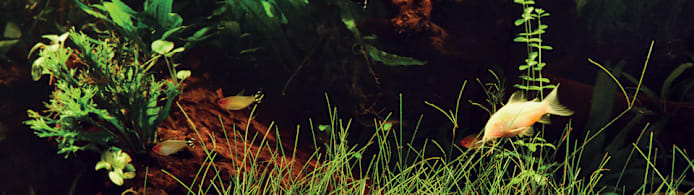
Learn how to pick the right aquarium plants, substrate, lighting, and fertilizers to ensure that your aquarium plants thrive and stay healthy.
Freshwater aquarium plants are an essential item to add to your aquatic habitat. While some pet parents opt for plastic plants for their freshwater aquarium, adding live aquatic plants can provide environmental benefits their fake counterparts can’t. Among other things, live aquatic plants produce oxygen and absorb carbon dioxide, help control algae growth, improve water quality and provide a renewable food source.
Although care for plastic plants requires less maintenance than live plants, aquarium plant care will become a regular part of your overall aquatic life maintenance plans. If you’ve decided to include the benefits of live plants in your freshwater aquarium, remember that thriving plants will likely mean thriving fish. Here are some tips on how to help achieve healthy aquatic plants.
Pick the right freshwater aquarium plant
An aquatic plant, by definition, is a plant that can survive when completely submerged under water— but different aquatic plants require different levels of care. Echinodorus, Lilaeposis (Sword Plants), Anarchies and Anubis are often recommended for freshwater aquariums as they are easier to care for species. Other examples of aquatic plants to consider include:
- Cryptocoryne
- Ludwigia
- Microsorium
- Vallisneria
- Hygrophila
- Bolbitis
When picking your plant life, don’t forget to check each plant’s compatibility with your water condition and fish. Some fish will dig up or even eat all the plants!
Choosing plastic plants for your aquarium requires fewer considerations than picking the right live aquatic plants for your fish’s habitat–such as the size and look of the plants and how they will fit into your aquarium.
Determine your freshwater aquarium plant substrate
Live freshwater aquarium plants generally come either potted or in a loose bunch. Although plants can typically grow in any aquatic substrate, the optimal condition for aquarium plants is 2 to 3 inches of laterite—a soil and rock combination that’s rich in iron and aluminum—covered with an inch of larger substrate, like gravel. If you won’t be using laterite, be sure to provide the plants with fish-safe food additives, iron supplements and fertilizers. Some aquatic plants could also benefit from the addition of CO2, as well. Removing any potted plants from their pots and planting them directly into the substrate can also be more conducive to root development.
Invest in a beneficial light source
You already know that light is an essential source of energy for plants to photosynthesize, but the type of aquarium plants you have should dictate the type of aquarium light you use for optimal growth. Most plants benefit from full-spectrum lighting and they generally need about 10 to 12 hours of light per day. Some plants have more specific needs, though. For example, some common freshwater aquarium light needs include:
- Dracaena sanderiana (bamboo): This easy-to-care for plant is a favorite for betta habitats, and it does best in medium to high lighting
- Note: While dracaena sanderiana can be fully submerged in water for short periods of time, it should never be submerged in water for more than a month at a time. After that it needs to come out of the water for a rejuvenation period
- Bolbitis: Is often a good beginner plant and requires at least medium lighting to thrive
- Echinodorus: Typically only require a low to medium light, depending on the exact plant chosen
As you choose the various plants you want to add to your aquarium, consult an aquatics specialist to ensure that the lighting needs for your plants are complementary and can be accommodated in your specific aquarium.
Fertilize and practice aquascaping
A fish-safe, iron-based fertilizer can enhance your plant’s growth and overall vitality. However, be sure to keep an eye on all that growing! While some aquarium plants won’t require ongoing pruning, taller ones like Rotala Indica can grow across the surface of the water if not pruned. Since overgrowth in plants like this can block essential light, continually ensuring that they are cut back is essential for the health of the rest of your aquatic life. Remove all dead and decaying leaf plant particles, too, as these affect your aquarium’s overall water quality.
Keep your aquarium clean and water quality good
Like your fish, freshwater aquarium plants also require a clean environment for optimal growth. Cleaning your fish tank regularly with the appropriate fish tank cleaner can help, but it’s essential to stay on top of algae growth. Algae competes with aquarium plants for light and nutrients, but it’s not always as simple as using an algaecide, which may have adverse effects on your aquarium. Instead, opt to include one of a variety of herbivorous aquatic life to the tank to help keep algae in check, or physically remove the algae with an algae scraper every week. If you use fertilizer for your plants, avoid using one with phosphates, since algae thrive on phosphates.
Keep in mind that most plants prefer a pH level of 6.5 to 7.8 (though a few prefer a more alkaline or acidic environment) so continual water checks are essential for their care as well as the rest of your aquatic life.
With the proper care and attention, freshwater aquatic plants can be a beautiful way to add natural elements to your aquarium. Learn more about aquatic and terrarium plant care, or stop into your local Petco store to speak with a store partner.
Frequently Asked Questions
How often should I change the water in a freshwater planted aquarium? Most freshwater planted fish tanks benefit from a partial water change of 10–25% every one to two weeks to remove waste, replenish trace minerals and keep nitrate levels in check. The exact frequency depends on your fish load and plant density — heavier stocking means more frequent changes. Always treat tap water with a dechlorinator before adding it to the tank, and check pH (target 6.5–7.8 for most aquatic plants) each time you test your water.
What kind of lighting do freshwater aquarium plants need? Most freshwater aquarium plants thrive under full-spectrum lighting for 10–12 hours per day. Low-to-medium-light species like Echinodorus and Anubias are forgiving for beginners, while faster-growing stem plants and Bolbitis need at least medium intensity to stay healthy. Running your lights on a timer helps mimic a natural day/night cycle and discourages excess algae growth. Consult a Petco-knowledgeable aquatics partner to match your fixture's output to the specific plants in your tank.
How and when should I fertilize aquarium plants? A fish-safe, iron-based liquid fertilizer added according to the product label is the most straightforward approach for most planted tanks. If your gravel or sand bed lacks nutrients, root-tab fertilizers placed near heavy feeders like Echinodorus can support stronger root development. Avoid fertilizers that contain phosphates — algae thrive on phosphates and can quickly outcompete your plants for light and nutrients. If you are not using iron-rich laterite as your base layer, iron supplements become especially important for steady, vibrant growth.
Why is algae taking over my planted tank, and how do I control it? Algae and aquarium plants compete for the same light and nutrients, so an imbalance — too much light, excess nutrients or inconsistent water changes — tips the scales toward algae. Rather than reaching for an algaecide, which can harm sensitive plants and fish, try adding herbivorous aquatic life (such as certain snails or algae-eating fish), manually removing algae with an algae scraper each week and reducing your photoperiod if algae is persistent. Skipping phosphate-based fertilizers also removes a key algae fuel source.
Is it safe to keep live plants with all freshwater fish? Not always. Some fish — including certain cichlids and goldfish — will uproot, shred or eat live plants. Before adding any plant to your fish tank, check its compatibility with your current fish and your water parameters (temperature, pH, hardness). Species like Anubias and Java Fern are often more resistant to nibbling because of their tougher leaves, but no plant is completely fish-proof with a determined digger. When in doubt, ask a Petco-knowledgeable aquatics partner for species-specific guidance. If a fish or plant ingests something potentially harmful, contact the ASPCA Animal Poison Control Center for guidance. the ASPCA
How do I prune aquarium plants, and what do I do with dead leaves? Trim fast-growing stem plants like Rotala Indica before they reach the water's surface and begin blocking light for lower-growing species. Use sharp, clean aquatic scissors and cut stems just above a leaf node to encourage bushy regrowth. Remove all dead, yellowing or decaying leaves promptly — decomposing plant matter raises ammonia and nitrate levels, which stresses both plants and fish. Dispose of trimmings outside the tank rather than leaving them to break down in the water.
Popular Freshwater Aquarium Plants at a Glance
Use this table to match plants to your fish tank setup before you buy. Light levels are measured in watts per gallon (WPG) or described by fixture output; ask a knowledgeable Petco aquatics partner if you need help reading your current light's specs.
| Plant Name | Light Requirement | Difficulty Level | Growth Rate | Ideal Placement | Notes |
|---|---|---|---|---|---|
| Anubias | Low (1–2 WPG) | Beginner | Slow | Midground / attached to décor | Tie to driftwood or rock; burying the rhizome causes rot |
| Java Fern (Microsorium pteropus) | Low (1–2 WPG) | Beginner | Slow–Moderate | Midground / background | Attach to hardscape; roots should not be buried |
| **Echinodorus (Sword Plant) | Low–Medium (1.5–3 WPG) | Beginner–Intermediate | Moderate | Background | Heavy root feeder; benefits from root tabs in the gravel |
| Cryptocoryne | Low–Medium (1.5–2.5 WPG) | Beginner | Slow–Moderate | Midground | May melt briefly after planting; recovers with stable water chemistry |
| Vallisneria | Medium (2–3 WPG) | Beginner | Fast | Background | Spreads via runners; prune regularly to prevent surface blockage |
| Hygrophila | Medium (2–3 WPG) | Beginner | Fast | Background | Trim stems weekly; cuttings can be replanted to fill gaps |
| Ludwigia | Medium–High (2.5–3.5 WPG) | Intermediate | Moderate–Fast | Background | Higher light intensifies red coloration; monitor for algae competition |
| Bolbitis (African Water Fern) | Medium (2–3 WPG) | Beginner–Intermediate | Slow | Midground | Attach to hardscape; good choice for shaded corners of the fish tank |
| Rotala Indica | Medium–High (2.5–3.5 WPG) | Intermediate | Fast | Background | Prune frequently — stems reach the surface and block light for lower plants |
| Dracaena sanderiana (Lucky Bamboo) | Medium–High (2.5–3.5 WPG) | Beginner | Moderate | Background / emergent | Never fully submerge for more than one month; requires periodic air exposure |
Quick tip: Most freshwater aquarium plants thrive at a pH of 6.5–7.8 and need 10–12 hours of full-spectrum light per day. Pair plants with similar light requirements so one fixture can serve the entire fish tank without leaving any species under- or over-lit.
Frequently Asked Questions
How often should I fertilize freshwater aquarium plants? Most live freshwater plants benefit from a fish-safe, iron-based liquid fertilizer added once a week, or root tabs replaced every one to three months for heavy root feeders like Sword Plants. Avoid fertilizers containing phosphates, as phosphates fuel algae growth and can quickly tip the balance against your plants. When in doubt, follow the product label and consult a knowledgeable Petco aquatics partner.
What is the best gravel or sand for aquarium plants? The source article's recommended setup is 2–3 inches of laterite — an iron- and aluminum-rich soil-and-rock combination — topped with about an inch of coarser gravel. If laterite isn't available, supplement a standard aquarium gravel bed with iron supplements and fish-safe fertilizers to give roots the nutrients they need.
How do I control algae without harming my aquarium plants? Skip algaecides when live plants are present, as these products can damage or kill your plants alongside the algae. Instead, physically remove algae weekly with an algae scraper, add herbivorous fish or invertebrates (such as certain snails or plecos) to graze on it naturally, and avoid phosphate-based fertilizers that give algae a competitive edge. Maintaining consistent lighting schedules — no more than 10–12 hours per day — also discourages algae blooms.
Can I keep live plants with fish that dig or eat vegetation? Some fish species will uproot, nibble or completely consume live plants. Before adding any plant to your fish tank, check that it is compatible with the fish already living there. Hardy, low-growing species like Anubias (attached to hardscape rather than planted in gravel) tend to hold up better in tanks with curious or plant-eating fish. A Petco aquatics partner can help you match plant and fish species before you buy.
How much light do freshwater aquarium plants really need? Most freshwater aquarium plants do well with 10–12 hours of full-spectrum light per day. Species vary: low-light plants like Anubias and Java Fern tolerate 1–2 watts per gallon, while faster-growing stem plants such as Rotala Indica and Ludwigia need 2.5–3.5 watts per gallon to thrive. Using a timer on your aquarium light ensures a consistent photoperiod, which benefits both plants and fish.
When should I call a veterinarian about my fish? If you notice unusual fish behavior — lethargy, loss of appetite, abnormal swimming, visible lesions or rapid gill movement — after changing your plant setup, water chemistry or fertilizer routine, consult your veterinarian as soon as possible. Sudden shifts in pH, CO₂ levels or chemical additives can stress fish quickly.
This article was created with assistance from AI tools and reviewed for accuracy by Petco's content team.


