


Two Easy Ways to Start Earning Rewards!
Become a member today! Members-only pricing and offers, personalized care notifications, Vital Care points back on every purchase and more!
 Become a credit card member today!
Earn 2X Pals Rewards points at Petco
when you use Petco Pay!APPLY NOWLearn More About Petco Pay Benefits
Heating & Lighting for Bearded Dragons: Full Guide
Published on September 18th, 2023
Updated on June 18th, 2026

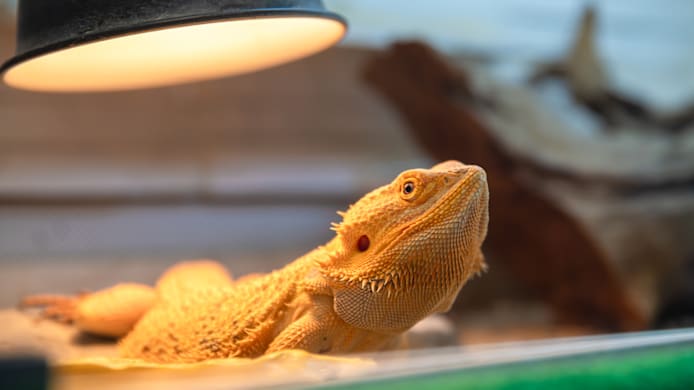
Bearded dragons have specific lighting requirements that emulate their natural warm and dry habitat. Learn about their lighting needs at Petco.
Heating and Lighting for Bearded Dragons: What You Need to Know First
Bearded dragons need three types of light working together every day: UVA light, UVB light, and a heat source. Get all three right, and your bearded dragon can digest food, absorb calcium, regulate his body temperature, and behave naturally. Miss one, and his health can decline quickly. That's the short answer — here's what it means in practice.
What Lights Does a Bearded Dragon Need?
A complete lighting setup for a bearded dragon includes:
- UVB light — essential for synthesizing vitamin D3, which allows your bearded dragon to absorb calcium from his food. Without adequate UVB exposure, bearded dragons are at serious risk of metabolic bone disease.
- UVA light — supports normal behavior, appetite, activity cycles, and psychological wellbeing. Most reptile-specific bulbs emit UVA alongside UVB.
- A heat source — bearded dragons are ectotherms, meaning they rely entirely on external warmth to regulate their body temperature. A basking lamp, halogen bulb, or ceramic heat emitter provides the thermal gradient they need to digest food and stay active.
Your bearded dragon needs 10–12 hours of this simulated daylight every day. A consistent light cycle — on in the morning, off at night — mimics the natural rhythm his body is built around and helps prevent stress.
Bulb types that can deliver UVA and UVB include:
| Bulb Type | Provides Heat | Provides UVB | Common Use |
|---|---|---|---|
| Fluorescent (linear or compact) | No | Yes | UVB strip along the habitat ceiling |
| Mercury vapor | Yes | Yes | All-in-one basking + UVB option |
| Halogen / incandescent | Yes | No (UVA only) | Basking spot lamp |
| Ceramic heat emitter | Yes (heat only) | No | Nighttime warmth without light |
Most pet parents use a combination — a linear UVB fluorescent tube paired with a separate halogen or incandescent basking bulb — to give precise control over both light quality and temperature.
Why Bearded Dragons Need This Setup: Life in the Wild
Bearded dragons are native to Australia's warm, arid interior — open scrublands, deserts, and dry forests where sunlight is intense and largely unfiltered. In the wild, a bearded dragon spends much of his day perched on a rock, log, or elevated surface, positioning his body to absorb as much direct sun as possible.
That sun delivers the full spectrum: UVA rays that drive normal behavior and appetite, UVB rays that trigger vitamin D3 synthesis in the skin, and radiant heat that warms his core so he can move, hunt, and digest. When the sun sets, his body temperature drops and he becomes inactive — a rhythm that repeats daily.
Inside a home habitat, nothing in the environment replicates sunlight automatically. Standard household bulbs produce light but virtually no UVB. Glass and most plastics filter out UVB entirely, which is why placing a habitat near a sunny window does not substitute for a proper UVB lamp. Replicating what the Australian sun provides — across all three dimensions of light — is the entire goal of a bearded dragon lighting setup.
A note from our Petco associates: If you're ever unsure whether your current bulbs are delivering adequate UVB output, a UVB meter can take the guesswork out of it — and your veterinarian can help you assess your bearded dragon's vitamin D and calcium status at a routine wellness visit.
Temperature and Lighting Requirements
Bearded dragons are happiest when they have a thermal gradient in their habitat:
- Cooler end: Around 75 degrees
- Warmer area: Around 90 degrees
- Basking area: Around 100 degrees
Being diurnal, you’re going to want to give your bearded dragon 10-12 hours of “daylight” and 10-12 hours of rest with either no lights, red light, night light, or ceramic heat emitters. It’s important to remember that since they’re in a warmer environment, their nighttime temperature shouldn’t fall below 70 degrees; if it does, you should compensate with one of the prior mentioned nighttime bulb types.
UVB lighting is crucial to the health of your bearded dragon; you should be providing UVB in conjunction with your UVA or daytime heat bulb. Together, the UVA and UVB will help imitate the sun, giving your bearded dragon the benefits from it to help live a happy and healthy life!
Ultraviolet A (UVA)
UVA – Provides heat and stimulates appetite, mating, and sleeping, while helping reptiles see the world more clearly. These bulbs come in many different colors to benefit diurnal and nocturnal reptiles alike.
Ultraviolet B (UVB)
UVB – Helps reptiles synthesize vitamin D3 and absorb calcium, crucial for healthy growth and development. It’s important to remember that a UVB bulb should be changed every 6 months to ensure the output of UVB is adequate for the reptile; visible light emission is not an indicator that the UVB bulb is working correctly.
Types of Bulbs
- Incandescent – Available in UVA & UVB; this is the most common bulb used for heating and basking areas, available in all shapes and sizes for any enthusiast’s needs.
- Halogen – Available in UVA & UVB; these bulbs are relatively new to the hobby compared to their older brother, the incandescent heat bulb. Halogen bulbs are more efficient, resulting in less energy consumption, and come in a standard and mini size, which helps fit the needs of most reptile habitats.
- Metal halide – Available in UVA & UVB; this bulb can be very high powered and needs a ballast to work.
- Linear Fluorescent – Most commonly a UVB bulb; these are the longer horizontal tube bulbs that are common in the reptile hobby.
- Compact Fluorescent – Available in UVA & UVB; these bulbs are known for their coil design and smaller form, which helps save space!
- Mercury Vapor – Available in UVA & UVB; these bulbs produce a fair amount of heat, so ensuring you have a quality lamp fixture is important.
- Ceramic – Very durable and offer a high amount of heat with little to no light emitted. Ensure the use of a ceramic lamp fixture as these bulbs produce a high amount of heat. Use caution, as the bulb may appear off, so extra care must be taken when attempting to handle the bulb.
As temperature is a critical component to your reptile’s health, always be sure to have a working temperature gauge to monitor your heat source to ensure it is working efficiently and safely!

Frequently Asked Questions
How many hours of light do bearded dragons need per day? Bearded dragons need 10–12 hours of simulated daylight and 10–12 hours of darkness (or low-heat nighttime lighting) every day. Matching this cycle to a consistent schedule helps support healthy digestion, appetite and sleep patterns.
What temperature should a bearded dragon's basking spot be? Your bearded dragon's habitat should maintain a thermal gradient: a cooler end around 75°F, a warm side around 90°F and a dedicated basking spot reaching approximately 100°F. Nighttime temperatures should not drop below 70°F — if they do, use a ceramic heat emitter, red bulb or night bulb to compensate. Always monitor temperatures with a reliable thermometer rather than estimating by touch.
Do bearded dragons need both UVA and UVB light? Yes — both types work together to mimic natural sunlight. UVA light supports appetite, activity, mating behavior and visual clarity, while UVB light enables your bearded dragon to synthesize vitamin D3, which is essential for calcium absorption and healthy bone development. Running both simultaneously gives your dragon the full spectrum of benefits it would receive basking in the wild.
How often should I replace my bearded dragon's UVB bulb? Replace UVB bulbs every six months, even if the bulb still appears to be emitting visible light. UVB output degrades well before the bulb burns out, so a glowing bulb is not a reliable sign that adequate UVB is still being produced. Mark your calendar when you install a new bulb so you never miss a replacement.
Can I use a regular household bulb for my bearded dragon's basking light? Standard household bulbs are not formulated to emit the UVA or UVB wavelengths bearded dragons require. Reptile-specific incandescent, halogen or mercury vapor bulbs are purpose-built to deliver the correct light spectrum and heat output. Using the wrong bulb can lead to vitamin D3 deficiency and metabolic bone disease over time — consult your veterinarian if you have concerns about your dragon's lighting setup.
What type of bulb is best for nighttime heating? Ceramic heat emitters are a popular choice for nighttime warmth because they produce significant heat with little to no visible light, helping preserve your dragon's natural day/night cycle. Red bulbs and dedicated night bulbs are also options. Whichever you choose, always use a fixture rated for the bulb's heat output — ceramic emitters in particular generate high temperatures and require a ceramic-socket lamp fixture for safe use.
Bearded Dragon Bulb Types at a Glance
Choosing the right bulb for your bearded dragon's habitat can feel overwhelming with so many options on the market. Use this comparison table to weigh UVA/UVB output, typical lifespan, relative cost, and best use case — so you can build a lighting setup that truly mimics the Australian sun your dragon needs.
| Bulb Type | UVA Output | UVB Output | Avg. Lifespan | Relative Cost | Best Use |
|---|---|---|---|---|---|
| Incandescent | Yes | Low (specialty bulbs only) | 750–2,000 hrs | $ Low | Basking spot heat; widely available in all shapes and sizes |
| Halogen | Yes | Low–Moderate (specialty bulbs only) | 2,000–4,000 hrs | $$ Moderate | Efficient basking heat; standard and mini sizes fit most habitats; lower energy draw than incandescent |
| Linear Fluorescent (T5/T8) | ➖ Minimal | High (10.0 UVB recommended for bearded dragons) | ~6 months active UVB output | $$ Moderate | Primary UVB source; replace every 6 months even if the tube still glows visibly |
| Compact Fluorescent (CFL) | Yes | Moderate | ~6 months active UVB output | $ Low–Moderate | Space-saving UVB option; coil design fits smaller fixture footprints |
| Mercury Vapor | Yes | High | 6–12 months | $$$ High | All-in-one heat + UVB; requires a quality, heat-rated lamp fixture |
| Metal Halide | Yes | High | 6–12 months | $$$$ Very High | High-powered output for large or tall habitats; requires a compatible ballast |
| Ceramic Heat Emitter (CHE) | ➖ None | ➖ None | 2–5 years | $$ Moderate | Nighttime heat only; emits no visible light; must use a ceramic-rated fixture |
Key notes for every bulb type: - UVB output degrades long before a bulb burns out. Replace any UVB-producing bulb on a 6-month schedule regardless of whether it still emits visible light — your bearded dragon's ability to synthesize vitamin D3 and absorb calcium depends on adequate UVB intensity. - Calcium deficiency and metabolic bone disease are serious risks when UVB is insufficient. Consult your veterinarian if you notice lethargy, soft jaw, or limb weakness in your dragon. - Always pair a UVB bulb with a UVA/basking heat source to maintain the full thermal gradient your dragon needs: a cooler end around 75°F, a warm side around 90°F, and a basking spot near 100°F. - Monitor all heat sources with a reliable temperature gauge — never estimate by feel alone.
Frequently Asked Questions
How many hours of light does a bearded dragon need each day? Bearded dragons need 10–12 hours of simulated daylight followed by 10–12 hours of darkness or low-heat nighttime lighting (such as a ceramic heat emitter or red/night bulb). This cycle mirrors the diurnal rhythm of their native Australian environment and supports healthy digestion, appetite, and sleep.
Do bearded dragons need both UVA and UVB light? Yes — both wavelengths serve distinct roles. UVA light stimulates appetite, natural behavior, and clearer vision, while UVB enables your dragon to synthesize vitamin D3, which is essential for calcium absorption and healthy bone development. Running both bulbs simultaneously gives your dragon the closest approximation to natural sunlight.
How often should I replace my bearded dragon's UVB bulb? Replace UVB bulbs every six months, even if the bulb still appears to be working. Visible light is not a reliable indicator of UVB output — the ultraviolet spectrum degrades well before the bulb stops glowing, leaving your dragon without the UVB it needs to stay wholesome.
What temperature should a bearded dragon's habitat be at night? Nighttime temperatures should not drop below 70°F. If your home runs cooler than that, use a ceramic heat emitter or an appropriate nighttime bulb to maintain warmth without disrupting your dragon's dark cycle. Always verify temperatures with a calibrated thermometer or temperature gauge.
Is a mercury vapor bulb a good all-in-one option for bearded dragons? Mercury vapor bulbs do produce both UVA heat and high UVB output from a single fixture, which can simplify your setup. However, they generate significant heat and require a quality, heat-rated lamp fixture to operate safely. They also carry a higher upfront cost than fluorescent or incandescent options. If you're unsure whether a mercury vapor bulb is right for your specific habitat size and setup, speak with a knowledgeable Petco associate or your veterinarian.
Can I use a regular household bulb for my bearded dragon's basking spot? Standard household incandescent bulbs can provide some heat, but they are not formulated to deliver the UVA or UVB output your dragon needs for long-term wellness. Always choose bulbs specifically designed for reptile habitats, and pair any heat-only bulb with a dedicated UVB source to ensure your bearded dragon gets the full spectrum of light it requires.
This article was created with assistance from AI tools and reviewed for accuracy by Petco's content team.
Related Articles


Bearded Dragon Lighting FAQs
No, UVA and UVB bulbs used to simulate daylight shouldn’t be used more than 12 hours a day. Bearded dragons need dark so they can get adequate sleep. However, if your home drops below 70 degrees Fahrenheit at night, you will need to use a heat bulb that doesn’t emit visual light to help your pet stay warm.
10 to 12 hours. This is roughly the same amount of time they’d spend basking in the sun of their natural desert habitat. Sunlight—real or simulated—is essential for bearded dragons to metabolize calcium and create vitamin D3, as well as regulate important biological functions. Any less will cause health issues, and any more will disrupt their sleep cycle.
Bearded dragon lighting should be placed at the top of your pet’s habitat or attached to a lid for even coverage. You should also position and arrange your lights and heat lamps to create two zones in your habitat: one that’s at least 100 degrees Fahrenheit for basking and one that’s at least 70 degrees for normal daytime living.