


Two Easy Ways to Start Earning Rewards!
Become a member today! Members-only pricing and offers, personalized care notifications, Vital Care points back on every purchase and more!
 Become a credit card member today!
Earn 2X Pals Rewards points at Petco
when you use Petco Pay!APPLY NOWLearn More About Petco Pay Benefits
Fish Aquarium Lamps: The Complete Lighting Guide
Published on December 18th, 2023
Updated on June 18th, 2026


Reviewed by Don Spaeth
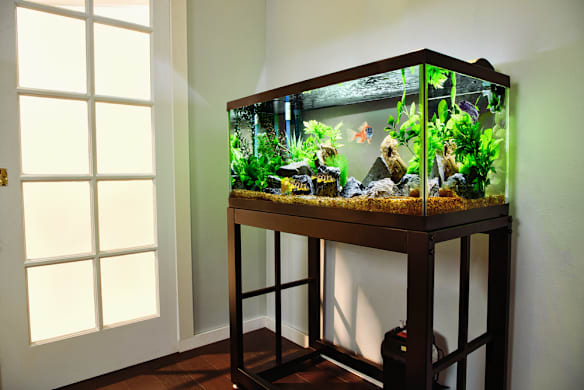
We can help you navigate your way through all the types of lights in fish tanks and determine which type is best for your aquarium.
Choosing Fish Aquarium Lamps: What Every Pet Parent Needs to Know
The right fish aquarium lamp does far more than help you see your fish — it drives photosynthesis, supports fish coloration and behavior, and keeps photosynthetic species like live plants, anemones and coral alive. Without adequate lighting, fish can lose their vibrant coloration, become lethargic or fall ill. https://www.merckvetmanual.com/all-other-pets
If you're standing in the lighting aisle feeling overwhelmed, you're not alone. Aquarium lighting is one of the most debated topics among aquarists, and the sheer number of lamp types, specs and acronyms can be a lot to take in — especially if you're new to the hobby. Here's how to cut through the noise.
The Key Terms on Every Lamp Package — Decoded
Before you can choose the right lamp for your fish tank, you need to understand what those numbers and letters on the packaging actually mean. Here's a plain-language breakdown:
Wattage Wattage tells you how much electrical energy a lamp consumes to run — not how much light it actually produces. This distinction matters: a compact fluorescent or LED lamp at 20 watts can outshine a conventional incandescent bulb at 60 watts. Don't shop by wattage alone.
Lumens Lumens measure the total quantity of visible light a lamp emits. This is the number that tells you how bright your fish tank will actually be. When comparing fish aquarium lamps, lumens are a more reliable guide to light output than wattage.
Kelvin (Color Temperature) The Kelvin scale describes the color of the light a lamp produces — not how hot it runs. Use this as your guide:
| Kelvin Range | Light Color | Best For |
|---|---|---|
| Below 4,000 K | Warm — reds, yellows, oranges | Freshwater community fish tanks; enhancing warm fish coloration |
| 5,500 K–6,500 K | Neutral to cool — whites, greens | General planted fish tanks; balanced spectrum |
| 6,500 K–10,000 K | Cool — blues, greens, violets | Reef fish tanks; mimicking deeper ocean light |
| 14,000 K–20,000 K | Very cool — deep blue/actinic | Saltwater and reef fish tanks; coral and anemone growth |
PAR (Photosynthetically Active Radiation) If your fish tank includes live plants, anemones or coral, you'll encounter PAR. It measures the intensity of light in the 400 nm–700 nm wavelength range that actually penetrates the water column and is available for photosynthesis. Higher PAR values mean more energy reaching your photosynthetic species — critical for reef and planted setups.
A Quick Primer on Light Itself
Visible light is electromagnetic radiation that the human eye can detect, measured in nanometers (nm). That visible window runs from roughly 400 nm (violet) to 700 nm (red) — the full spectrum of a rainbow. Radiation below 400 nm is ultraviolet (UV); above 700 nm is infrared. Fish aquarium lamps are engineered to deliver specific portions of this spectrum depending on what your fish tank needs.
The Main Types of Fish Aquarium Lamps
There are five primary lamp technologies you'll encounter when shopping for aquarium lighting. Each has a different profile of light output, energy use and ideal application:
| Lamp Type | Key Characteristics | Typical Best Use |
|---|---|---|
| Incandescent | Low upfront cost; high heat output; limited spectrum; high energy use | Basic fish-only fish tanks (increasingly rare) |
| Fluorescent — T12 | Older, thicker tube; lower efficiency than newer fluorescents | Legacy hoods and older setups |
| Fluorescent — T8 | Mid-range efficiency; widely available; good color options | Freshwater community and planted fish tanks |
| Fluorescent — T5 | Slimmer, higher output than T8; excellent color rendering | Planted fish tanks; some reef applications |
| Compact Fluorescent (CFL) | High lumens for lower wattage; fits smaller hoods | Smaller freshwater and marine fish tanks |
| Metal Halide (MH) | Very high intensity; deep light penetration; generates heat | Large reef and deep fish tanks requiring high PAR |
| LED | Energy-efficient; low heat; long lifespan; programmable spectrum and intensity on many models | All fish tank types — freshwater, planted, reef |
LED fish aquarium lamps have become the most popular choice across all tank types because they combine energy efficiency with the flexibility to dial in the exact spectrum your fish tank requires. Many LED fixtures allow you to program sunrise-to-sunset cycles, which supports natural fish behavior and can help reduce stress. https://www.merckvetmanual.com/all-other-pets
Matching Your Lamp to Your Fish Tank's Needs
Not every fish tank needs the same light. Here's how to narrow your choice:
- Fish-only freshwater fish tanks: A moderate-output lamp in the 5,500 K–6,500 K range is a solid starting point. Focus on lumens sufficient to illuminate the full length of your fish tank without promoting excessive algae growth.
- Planted freshwater fish tanks: Live plants need consistent light in the PAR range (400–700 nm). T5 fluorescent or full-spectrum LED lamps with a Kelvin rating around 6,500 K work well. Aim for a consistent photoperiod — typically 8–10 hours per day — to support plant growth without triggering algae blooms.
- Saltwater fish-only fish tanks: Cooler color temperatures (10,000 K range) mimic open-ocean light and make marine fish colors pop.
- Reef fish tanks with coral and anemones: These photosynthetic animals depend on high-PAR, full-spectrum light. Metal halide or high-output LED fixtures with actinic (blue/violet) channels are typically required. Consult your veterinarian or a knowledgeable Petco associate if you're unsure whether your current lamp is meeting your coral's needs.
Pair the right lamp with a quality fish tank and appropriate gravel or sand to create an environment where your fish and plants can truly thrive.
Quick Tip: If you notice your fish's colors fading, increased lethargy or poor plant growth despite regular feeding and water changes, your lighting spectrum or photoperiod may be the culprit. Review your lamp's Kelvin rating, lumen output and daily light schedule before adjusting other variables — and when in doubt, consult your veterinarian.
Incandescent bulbs
While incandescent lights were popular in the past, Aquarium Fish International, an organization for fish pet parents, does not recommend them because the lights waste about 95 percent of input energy and do not provide the spectral output for photosynthesis. Additionally, this type of light doesn't enhance the colors of your fish for viewing as well as other lighting options do. While incandescent bulbs are inexpensive, the bulbs also burn out quickly, which can create extra maintenance and expense. If you go this route, it is essential to use a wattage that is designed for the aquarium hood, such as 25-watt bulbs or less. Higher wattage bulbs can damage the aquarium hoods and be a potential fire hazard.
Although they are slowly being phased out, incandescent bulbs are still available and used by some aquarists. These types of bulbs and fixtures were generally utilized for smaller-sized aquariums because they were a cheaper alternative to fluorescents.
Fluorescent bulbs
Fluorescent lighting was one of the most common types of aquarium lighting for years. These fixtures and bulbs are more expensive than incandescent, but fluorescent bulbs utilize less power than incandescent bulbs, and last longer, which may save you money over the life of the fixture.
The fluorescent lighting selection consists of T5, T8, T12, Normal Output (N.O.), High Output (H.O.), and Very High Output (V.H.O.). There are numerous bulb options such as full spectrum, color-enhancing, actinic, and plant. With the numerous fluorescent lighting options from sizes to spectrum, there is a fixture that can meet the needs of most aquariums and aquarists.
Standard output fluorescents will suit most fish-only aquariums. High output and very high output fluorescent lighting are great options for aquarists maintaining corals or planted aquariums. These fixtures and bulbs do cost more and require high output ballasts to power these bulbs, but they can produce nearly 3 times the lighting as a standard output fluorescent bulb.
Compact fluorescent bulbs
Similar to fluorescent light bulbs, power compacts are two smaller tubes with a single end. They provide higher lighting output than a single standard fluorescent bulb. Power compacts come in dual and quad tube configurations, making them an ideal upgrade from a single fluorescent bulb fixture. Power compacts also provide different color temps suitable for most aquatic needs.
Metal halide lighting
Metal Halide lighting, created from a fusion of halide salts and mercury vapor, has been heavily utilized for indoor horticulture and is widely popular for coral, planted, large, and deep aquariums. These HID bulbs can produce intense, full spectrum lighting within a single bulb suitable for aquarium use, coming the closest to replicating natural sunlight. A few drawbacks with metal halide are that they draw a lot of electricity to operate and generate a lot of heat, which can increase water temperature.
Some aquatic pet parents opt for this high intensity discharge (HID) lighting system that produces intense light from a single point source. Pet parents can also choose from a large variety of spectral outputs based on the type of aquatic life in their aquarium. Additionally, the systems provide a good environment for photosynthesis, making it a popular choice for aquariums with live plants and corals. Because metal halide lamps generate a high output point source light, this type of lighting is a good option for large tanks and those deeper than two feet. Metal Halide lighting generates a lot of heat, so depending on the size of your tank and the number of lamps, you may need to install a fan and/or chiller on the tank to keep the water from becoming too hot.
LED (light emitting diodes)
The newest additions to the lighting world are LEDs (light emitting diodes). This is a semiconductor light source that emits light when an electrical current flows through it. LEDs are energy efficient, and capable of producing intense lighting for smaller-sized aquariums without generating heat in the tank. They have a long operating life, omitting the need for bulb replacement as with other lighting options. Some fixtures have the ability to increase and decrease in intensity slowly, simulating a sunrise and sunset effect. Some negatives with LEDs are that they tend to be more expensive when compared to other forms of lighting. If a diode fails, it is not as easy to replace as a bulb.
What Light Best Suits Your Fish Tank?
The right fish aquarium lamp depends first on what lives in your tank — fish only, live plants, or photosynthetic corals and invertebrates. Start there, and the choice becomes much clearer.
| Tank Type | Recommended Lamp | Why It Works |
|---|---|---|
| Fish only (bright room) | Ambient light or basic fixture | Fish don't require a specific spectrum; light is primarily for viewing |
| Fish only (dark room) | Full-spectrum fluorescent or LED | Enhances fish color and visibility without specialized output |
| Live planted tank | High-output fluorescent (plant-rated) or full-spectrum LED | Delivers the intensity and spectrum plants need for photosynthesis |
| Large or deep planted tank | Metal halide | Penetrates depth; sustains high light demand |
| Reef / coral / photosynthetic invertebrates | Reef-rated LED or purpose-built reef fixture | Replicates the intensity and spectrum zooxanthellae require |
Fish-Only Tanks
If your tank houses fish only, lighting is primarily for your benefit — so you can see and enjoy your fish. That said, fish kept in prolonged darkness can lose their color, and some species may develop health concerns over time. A few practical points:
- Well-lit room: Ambient light from a nearby window may be sufficient. You can supplement with a basic fixture during evening viewing hours.
- Dark room: A full-spectrum fluorescent or LED fixture is a straightforward upgrade. Incandescent bulbs produce a warmer, more yellow cast that some pet parents find appealing; full-spectrum options render fish colors more vividly and naturally.
- Species matter: Some fish — the elephant nose is a well-known example — actively prefer lower-light environments. Research the preferences of your specific species before settling on an intensity level.
Petco tip: Browsing fish tanks and aquariums at the same time you choose a lamp is smart planning — tank depth and footprint directly affect how much light output you'll need.
Planted Tanks
Live plants depend on light for photosynthesis, so lamp selection here is a genuine biological requirement, not a style preference.
- Incandescent bulbs generally lack the intensity and spectral range that plants need and are not recommended for planted setups.
- Plant-rated fluorescent bulbs are widely available and some are formulated specifically to support photosynthesis — look for bulbs labeled for planted or freshwater-plant use.
- Full-spectrum LEDs can meet plant needs when the fixture offers a broad mixture of wavelengths across the visible spectrum. A single-color or "white only" LED strip may not cover all the spectral bands plants use.
- Metal halide fixtures are worth considering for very large or deep tanks where other light sources can't penetrate adequately to the substrate level.
Your goal is to replicate natural sunlight as closely as possible. Pairing the right lamp with a quality aquarium substrate and gravel — one suited to rooted plants — gives your planted tank the best foundation for lush, sustained growth.
Reef Tanks, Corals and Photosynthetic Invertebrates
Corals and many invertebrates contain symbiotic algae cells called zooxanthellae. These microscopic organisms live within coral tissue and use light for photosynthesis, producing nutrients that feed the coral or invertebrate host. Without adequate light intensity and spectrum, zooxanthellae cannot function properly, and the coral or invert will decline.
Key points for reef lighting:
- Many corals and invertebrates can adapt to artificial light, but the closer you match their natural light environment, the better they'll thrive.
- There are now numerous fixtures designed specifically for reef and coral aquariums, including programmable LEDs that allow you to dial in both spectrum and intensity.
- Reef-rated fixtures typically emphasize blue and actinic wavelengths that penetrate water depth and support zooxanthellae activity.
Consult your veterinarian or a knowledgeable aquatic specialist if you notice coral bleaching or invertebrate decline — these can signal lighting deficiencies alongside other water-quality issues.
How Much Light Does Your Tank Need Each Day?
Getting the daily light duration right matters as much as choosing the correct lamp type.
| Tank Type | Recommended Daily Light Duration |
|---|---|
| Fish only (ambient light available) | Supplement during evening hours as needed |
| Fish only (dark room) | 8–10 hours per day |
| Planted tank | 10–12 hours per day |
| Reef / coral / photosynthetic invertebrates | 10–12 hours per day (mirroring natural daylight cycles) |
Algae and Light: Clearing Up a Common Misconception
Bright lights alone do not cause algae blooms. Algae is a natural, photosynthetic organism that will eventually appear in most aquatic environments regardless of lighting. What triggers a bloom is the combination of elevated nutrients in the water and excessive light intensity or duration. Practical steps to keep algae in check:
- Don't place your tank in direct sunlight. A window that receives direct sun introduces uncontrolled light and heat that can fuel rapid algae growth.
- Keep nutrients in check. Regular water changes and appropriate feeding amounts reduce the fuel algae needs to bloom.
- Use a timer. Plugging your light fixture into an outlet timer removes the risk of accidentally leaving lights on too long and keeps your photoperiod consistent day to day.
Simulating Sunrise and Sunset: Why Gradual Transitions Matter
Sudden shifts from darkness to full brightness — or vice versa — are a genuine stressor for fish, corals and invertebrates. Think of it the way you'd think about your own eyes adjusting after walking out of a dark room into bright sunlight.
A few simple habits reduce light-related stress:
- If your tank is in a darker area, turn on a nearby room light first, wait a few minutes, then switch on the aquarium lamp.
- Use a programmable LED fixture. Many current LED models connect to a smartphone app or computer and include built-in timers that gradually ramp light intensity up in the morning and down in the evening — a reliable, automated way to simulate natural sunrise and sunset cycles.
- Keep your schedule consistent. Fish and corals acclimate to predictable light cycles. Irregular on/off patterns can be a low-grade, ongoing stressor.
With the right fish aquarium lamp matched to your tank's inhabitants — and a consistent, gradual lighting schedule — you give every species in your tank the environment it needs to show its best color and stay at its best.


