


Two Easy Ways to Start Earning Rewards!
Become a member today! Members-only pricing and offers, personalized care notifications, Vital Care points back on every purchase and more!
 Become a credit card member today!
Earn 2X Pals Rewards points at Petco
when you use Petco Pay!APPLY NOWLearn More About Petco Pay Benefits
Red-Eared Slider Turtle Habitat Setup Guide
Published on July 21st, 2023
Updated on June 18th, 2026

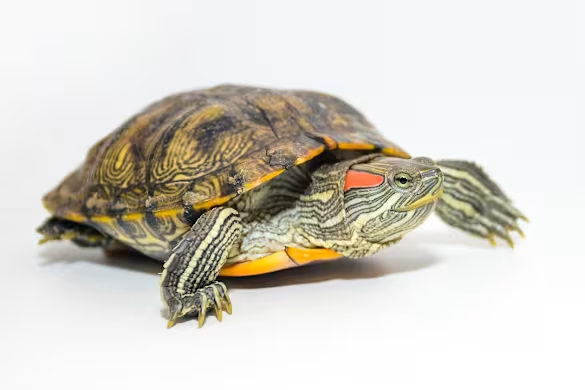
Red-eared sliders are primarily aquatic but will fully emerge from the water. Setting up a habitat that mimics their natural environment will help ensure your turtle is set up for a happy, healthy life!
When setting up a habitat for your red-eared slider, it is important to remember how they spend their time. The red-eared slider turtle is primarily aquatic and will fully emerge from the water to warm its body through basking on a solid surface. Setting up a habitat that mimics their natural environment will help ensure your aquatic turtle is set up for a quality life with you!
The Setup
Getting your red-eared slider's home right from day one is the single most important thing you can do for his long-term health. Below is everything you need to select, size and arrange a red-eared slider habitat that keeps him thriving.
Tank Size
The minimum aquarium size for a juvenile red-eared slider is 40 gallons — and bigger is always better. The widely accepted rule of thumb is 10 gallons of water per 1 inch of shell length. Because red-eared sliders can reach 10–12 inches as adults, plan ahead: a slider that starts in a 40-gallon tank will eventually need a 100-gallon or larger setup.
One important note on water depth: you generally won't fill the aquarium more than halfway, so factor that in when you're shopping. A taller tank doesn't automatically mean more usable swimming space — prioritize footprint (length × width) over height.
Substrate
The most popular choice for a red-eared slider habitat is larger rocks or smooth pebbles. The single non-negotiable rule: every piece of substrate must be larger than what your turtle can fit in his mouth. Red-eared sliders forage along the bottom for sinking food, and small gravel or pebbles can be swallowed accidentally, leading to choking or intestinal impaction — a serious and potentially life-threatening condition https://vcahospitals.com/know-your-pet.
| Substrate Option | Recommended? | Notes |
|---|---|---|
| Large river rocks / smooth pebbles | Yes | Must be larger than turtle's mouth opening |
| Fine gravel or small pebbles | No | Swallowing risk; can cause impaction |
| Bare bottom (no substrate) | Optional | Easiest to clean; less naturalistic |
| Sand | No | Too fine; high ingestion risk for turtles |
If you prefer a bare-bottom setup for easier maintenance, that's a perfectly acceptable choice — just make sure your filtration is doing its job.
Décor
Red-eared sliders are naturally curious and active, so a thoughtfully decorated habitat keeps them mentally engaged. Keep these guidelines in mind:
- Don't overcrowd the swimming area. Your turtle needs open water to move freely; décor should accent the perimeter, not fill the center.
- Avoid tight openings. Any decoration with a gap or tunnel your turtle can barely squeeze into is a trap — juveniles that fit today may become stuck as they grow.
- Live or artificial plants are fine, with caveats. Your turtle will very likely try to eat or uproot live plants, so treat them as temporary enrichment rather than permanent fixtures. Choose non-toxic species if you go the live route, and consult your veterinarian if you suspect your turtle has ingested a large quantity of any plant material https://www.aspca.org/pet-care/animal-poison-control.
Basking Area
A proper basking area is not optional — it's essential. Red-eared sliders are ectotherms that regulate their body temperature by moving between warm and cool zones. Your turtle must be able to completely and easily leave the water to bask, dry off and warm up https://www.merckvetmanual.com/all-other-pets.
Acceptable basking surfaces include:
- A commercial basking dock (floating or fixed)
- Driftwood sturdy enough to support his full weight
- A flat rock or stacked rocks with a gradual ramp into the water
- Any smooth, stable platform he can climb onto without assistance
Whatever you choose, position it directly under your heat and UVB lamp so your turtle gets the full benefit of both light sources while basking.
Filtration
Turtles are messy — far messier than most fish — and strong filtration is one of the most important investments you'll make for your red-eared slider's habitat. Inadequate filtration allows ammonia, nitrites and other harmful compounds to build up quickly, which can lead to respiratory infections, shell problems and other serious health issues https://vcahospitals.com/know-your-pet.
A submersible (in-tank) filter is recommended over a hang-on-back (HOB) filter for one key reason: submersible filters are designed to draw water efficiently at lower water levels, and you can adjust the height at which the filter is fixed to match your actual water depth. HOB filters are engineered for fully filled aquariums and often struggle with the half-filled conditions typical of a turtle setup.
Look for a filter rated for at least twice the volume of your aquarium — if you have a 75-gallon tank, choose a filter rated for 150 gallons. Turtles produce waste at a rate that quickly overwhelms a filter running at its stated capacity.
Screen Top with Clips
A screen top with secure clips is a must-have for every red-eared slider habitat. It serves two critical purposes:
- Escape prevention. Red-eared sliders are surprisingly strong and persistent climbers. A turtle that escapes his aquarium and falls can suffer serious injury.
- Burn prevention. A screen top keeps your turtle at a safe distance from heat lamps and UVB fixtures, which can cause thermal burns on direct contact.
Make sure the clips are sturdy enough that your turtle can't push the screen off from below — test them before leaving him unsupervised.
Lighting Fixtures
You'll need both UVA and UVB lighting in your red-eared slider's habitat. Together, these two light types replicate the full-spectrum benefits that sunlight provides to reptiles in the wild https://www.merckvetmanual.com/all-other-pets.
- UVB is essential for the production of Vitamin D3, which enables your turtle to absorb calcium and maintain strong, properly formed bones and shell. Without adequate UVB, red-eared sliders can develop metabolic bone disease — a painful and progressive condition.
- UVA helps stimulate appetite, supports normal activity cycles and can encourage natural behaviors like foraging and basking.
Plan to replace UVB bulbs every 6 months, even if they still appear to be lit — the UVB output degrades well before the visible light does.
Lighting and Heat
Two separate heat sources work together in a well-built red-eared slider habitat: the basking lamp (which warms the basking area to approximately 85–95°F) and the water heater (which maintains water temperature in the 75–80°F range for most sliders). Your UVB fixture should run on a consistent 10–12 hour light cycle to mimic natural daylight patterns and support your turtle's internal rhythms. Consult your veterinarian for temperature targets specific to your turtle's age and health status.
Nutrition & Supplements
Nutrition and supplementation are key components of your aquatic turtle's overall health. In the wild, a red-eared slider eats a wide variety of plant and animal matter — a diversity that contributes to a well-balanced diet for optimal health and development. Commercial aquatic turtle foods, paired with the correct vitamins and minerals, help provide a complete and balanced diet at home https://www.merckvetmanual.com/all-other-pets.
Feed a diet specifically formulated for aquatic turtles and their life stage (juvenile vs. adult diets differ in protein content). Calcium and Vitamin D3 supplements can help fill small nutritional gaps — particularly if your UVB lighting setup is not optimal. Ask your veterinarian which supplements are appropriate for your turtle and how often to use them.
Treats tip: Supplemental foods like feeder fish, leafy greens or fruit should make up no more than 10% of your turtle's total diet. His staple commercial turtle food should always be the foundation.
Maintenance
Water quality is one of the most significant factors in keeping your red-eared slider healthy. Poor water conditions are a leading cause of shell rot, respiratory infections and other diseases that are far harder to treat than they are to prevent https://vcahospitals.com/know-your-pet.
Every red-eared slider pet parent should have these maintenance essentials on hand:
- Aquarium water test kit — monitor ammonia, nitrite, nitrate and pH regularly
- Water conditioner formulated for aquatic turtles (neutralizes chlorine and chloramines)
- Gravel vacuum / siphon for partial water changes and debris removal
- Replacement filter media so you're never caught without it
Perform partial water changes of 25–30% weekly, or more frequently if your test kit shows elevated ammonia or nitrite levels. A full water change is rarely necessary and can disrupt beneficial bacteria in your filter — stick to partial changes as your routine.
The most effective way to treat a sick turtle is to prevent illness in the first place. With a properly sized aquarium, clean water, full-spectrum lighting and a nutritious diet, you and your red-eared slider are set up for a long, rewarding life together. If you ever notice changes in your turtle's appetite, activity level, shell appearance or breathing, contact your veterinarian promptly.
Red-Eared Slider Habitat Quick-Reference Guide
Use this table as your at-a-glance checklist when setting up or evaluating your red-eared slider's home. All ranges reflect general husbandry guidelines; consult your veterinarian for guidance specific to your turtle's age, size and health status.
| Parameter | Hatchling (shell < 2 in.) | Juvenile (shell 2–4 in.) | Sub-Adult / Adult (shell > 4 in.) |
|---|---|---|---|
| Minimum tank size | 20 gal. (upgrade quickly) | 40 gal. | 75–120+ gal. (10 gal. per 1 in. of shell) |
| Water depth | Shallow enough to right itself; ~1.5× shell length | Fill tank ~40–50% full | Fill tank ~40–50% full; deeper is better for swimming |
| Water temperature | 78–80 °F | 75–78 °F | 72–76 °F |
| Basking surface temp. | 88–92 °F | 88–92 °F | 85–90 °F |
| Ambient air temp. (above water) | 80–85 °F | 78–82 °F | 75–80 °F |
| UVB lamp output | 5.0 / 10.0 UVB bulb | 5.0 / 10.0 UVB bulb | 10.0 UVB bulb recommended |
| Photoperiod (light cycle) | 12–14 hrs light / 10–12 hrs dark | 12–14 hrs light / 10–12 hrs dark | 12–14 hrs light / 10–12 hrs dark |
| UVB bulb replacement | Every 6 months | Every 6 months | Every 6 months (output fades before visible light does) |
| Filtration rating | 2–3× tank volume per hour | 2–3× tank volume per hour | 3× tank volume per hour minimum |
| Partial water change | 25–30% weekly | 25–30% weekly | 25–30% weekly |
| Substrate size | Larger than turtle's mouth (avoid fine gravel) | Larger than turtle's mouth | Larger than turtle's mouth or bare-bottom tank |
https://www.merckvetmanual.com/all-other-pets https://vcahospitals.com/know-your-pet
Pro tip: Tank size is the parameter most commonly underestimated. A red-eared slider can reach 10–12 inches as an adult, so planning ahead for a larger home from the start saves time, money and stress on your turtle.
Frequently Asked Questions
What is the minimum tank size for a red-eared slider? A 40-gallon tank is the accepted minimum for a juvenile red-eared slider. The widely used rule of thumb is 10 gallons of water for every 1 inch of the turtle's shell length, so an adult slider will ultimately need 75 gallons or more. https://vcahospitals.com/know-your-pet
What water temperature does a red-eared slider need? Water temperature should generally be kept between 72–80 °F depending on the turtle's age, with warmer water (78–80 °F) for hatchlings and slightly cooler water (72–76 °F) for adults. A reliable submersible aquarium thermometer is essential for monitoring this consistently. https://www.merckvetmanual.com/all-other-pets
How hot should the basking area be for a red-eared slider? The basking surface should reach 85–92 °F so your turtle can fully thermoregulate — raising its core body temperature to aid digestion and immune function. Always provide a cooler water zone so your turtle can self-regulate between the two temperature gradients. https://www.merckvetmanual.com/all-other-pets
Why does a red-eared slider need UVB lighting? UVB light triggers the synthesis of Vitamin D3 in reptiles, which is essential for calcium absorption and healthy shell and bone development. Without adequate UVB exposure, red-eared sliders are at risk for metabolic bone disease. Replace UVB bulbs every six months even if they still appear to emit visible light, because UV output degrades well before the bulb burns out. https://vcahospitals.com/know-your-pet
How many hours of light does a red-eared slider need each day? A consistent photoperiod of 12–14 hours of light followed by 10–12 hours of darkness is recommended year-round. UVA light within this cycle can help support normal appetite and activity levels. A programmable outlet timer makes maintaining this schedule effortless. https://www.merckvetmanual.com/all-other-pets
Are any common aquarium plants or household items toxic to red-eared sliders? Some aquatic and houseplants can be harmful if ingested by turtles. The ASPCA Animal Poison Control Center maintains a searchable database of toxic plants and substances; consult it before adding live plants to your turtle's home, and contact your veterinarian or the ASPCA Poison Control hotline immediately if you suspect your turtle has eaten something harmful. https://www.aspca.org/pet-care/animal-poison-control
Frequently Asked Questions
How often should I change the water in a red-eared slider's tank? Partial water changes of 25–30% are recommended weekly for most red-eared slider setups, with a full water change and tank cleaning performed monthly. Because red-eared sliders produce significant waste, even a strong filter cannot replace regular water changes — consistent maintenance is the single most effective way to prevent the bacterial and fungal infections that thrive in poor water conditions. Always use a water conditioner formulated for aquatic turtles when refilling.
Can I use tap water in my red-eared slider's tank? Tap water is generally acceptable, but it must be treated with an aquatic-turtle-safe water conditioner before use. Municipal tap water contains chlorine and chloramines that can irritate a turtle's skin and eyes and disrupt the beneficial bacterial colonies in your filter. Let treated water reach room temperature before adding it to the tank to avoid shocking your turtle with a sudden temperature drop. Consult your veterinarian if you notice persistent eye irritation or skin changes in your turtle. https://vcahospitals.com/know-your-pet
Do red-eared sliders absolutely need a filter? Yes. Filtration is strongly recommended — not optional — for red-eared slider habitats. Turtles are considerably messier than most fish, releasing ammonia-heavy waste that can rapidly reach toxic levels without mechanical and biological filtration. A submersible in-tank filter sized for at least double your tank's actual water volume (since the tank is only filled partway) will handle the load most effectively and can be repositioned as water levels change. https://vcahospitals.com/know-your-pet
What water temperature does a red-eared slider need? Water temperature should be maintained between 75°F and 80°F for adult red-eared sliders, with the basking surface reaching 85°F–95°F so the turtle can fully thermoregulate. Temperatures outside these ranges can suppress immune function and appetite. Use a reliable submersible thermometer to monitor water temp and a separate surface thermometer or temperature gun for the basking area. If your turtle stops basking or eating, temperature imbalance is one of the first things to rule out — and a conversation with your veterinarian is the right next step. https://www.merckvetmanual.com/all-other-pets
How much UVB lighting does a red-eared slider need, and how often should bulbs be replaced? Red-eared sliders require UVB exposure for 10–12 hours per day to support Vitamin D3 synthesis and healthy calcium absorption. UVB output from fluorescent and mercury vapor bulbs degrades long before the bulb visibly burns out — most manufacturers recommend replacing UVB bulbs every 6 months even if they still appear to produce light. A timer makes maintaining a consistent photoperiod simple and ensures your turtle's biological rhythms stay on track. https://www.merckvetmanual.com/all-other-pets
Are any common aquarium plants or decorations toxic to red-eared sliders? Some live aquatic and semi-aquatic plants can be harmful if ingested, and because red-eared sliders are curious and will mouth or eat plants in their tank, plant selection matters. Avoid any plant treated with pesticides or fertilizers. If you are unsure whether a specific plant is safe for your turtle, consult your veterinarian before adding it to the habitat, or contact the ASPCA Animal Poison Control Center for guidance on potential plant toxicity. https://www.aspca.org/pet-care/animal-poison-control
This article was created with assistance from AI tools and reviewed for accuracy by Petco's content team.
Related Articles


