


Two Easy Ways to Start Earning Rewards!
Become a member today! Members-only pricing and offers, personalized care notifications, Vital Care points back on every purchase and more!
 Become a credit card member today!
Earn 2X Pals Rewards points at Petco
when you use Petco Pay!APPLY NOWLearn More About Petco Pay Benefits
Aquarium Salt in Freshwater Fish Tanks: Full Guide
Published on September 18th, 2023
Updated on July 16th, 2026

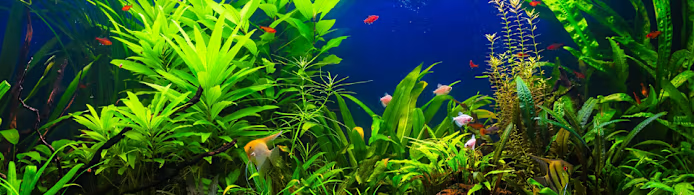
Learn how to use aquarium salt in freshwater aquariums to promote healthy gill functions, reduce stress, and treat infections in fish.
Can you use salt in a freshwater aquarium and how much?
Yes, adding 1 tablespoon of freshwater aquarium salt per 5 gallons of water can provide a number of benefits to your aquatic ecosystem. Be sure to only use freshwater aquarium salt (NOT marine salt) that has been made from evaporated seawater, as other types can harm your fish.
If you are unsure of how much salt is in your aquarium, especially after a water change, the use of a refractometer is the most precise way to measure the specific gravity in your aquarium.
Remember, for the health of your aquatic life, changing water parameters should be done gradually so be careful not to change your specific gravity more than 0.001 in a 24-hour period.
Even though this product is natural, caution should be taken as certain species of fish, especially scaleless fish, and plants are very sensitive to the effects of increased salinity in their habitat. It is best to follow the directions on the product, confer with your local aquatic specialist or reach out to the manufacturer’s customer service line if you have any questions.
The Benefits of Using Aquarium Salt in a Freshwater Fish Tank
Freshwater aquarium salt offers several concrete, well-documented benefits for fish health — from supporting everyday gill function to assisting with certain parasite treatments. Here's what it actually does, and why it matters.
Important note: Freshwater aquarium salt is made from evaporated sea water, but it is not the same as marine salt mix used in saltwater fish tanks. Marine salt contains additional minerals and buffers that can harm freshwater fish. Always use a product specifically labeled for freshwater aquariums.
What Aquarium Salt Does for Your Fish
1. Supports healthy gill function Fish gills are constantly working to regulate the balance of water and dissolved minerals across their membranes — a process called osmoregulation. A small amount of aquarium salt in the water can help ease that workload, particularly for fish that are stressed, recovering from illness, or adjusting to a new aquarium or fish tank.
2. Replenishes electrolytes Just like people, fish need electrolytes — sodium, potassium and chloride — to maintain healthy nerve and muscle function. Aquarium salt naturally restores electrolytes that can be depleted during illness, stress or water changes.
3. Reduces stress Stress is one of the leading contributors to disease in freshwater fish. By supporting osmoregulation and electrolyte balance, aquarium salt can help reduce the physiological stress load on your fish — giving their immune systems a better chance to function properly.
4. Promotes and protects the slime coat Fish produce a thin mucus layer — called the slime coat — that acts as their first line of defense against bacteria, parasites and physical injury. Aquarium salt can help stimulate and reinforce this protective barrier, which is especially valuable for fish recovering from fin damage, netting stress or minor wounds.
5. Supports wound healing The mild osmotic effect of salt in the water can help reduce the risk of secondary infection in fish with minor abrasions or torn fins, supporting the natural healing process.
6. Assists with certain parasitic infections Aquarium salt can be a useful tool against some external parasites — such as ich (Ichthyophthirius multifiliis) — by disrupting the parasite's ability to regulate water across its own membranes. It can also improve the effectiveness of medications used alongside it. Merck Veterinary Manual
Salt Baths and Dips vs. Ongoing Maintenance Dosing
One important distinction: the salt concentration used for baths or dips is significantly higher than the low, maintenance-level dose kept in the fish tank day to day. These are two separate applications with different purposes.
| Application | Typical Use | Duration | Salt Concentration |
|---|---|---|---|
| Maintenance dose | Everyday electrolyte support, stress reduction, slime coat health | Ongoing | Low (per product label) |
| Salt bath / dip | Targeted treatment for external parasitic infections | Minutes to hours | Higher (per product label or vet guidance) |
Salt baths and dips should be performed carefully and with close observation of your fish. If you're unsure about the correct concentration or duration for a bath or dip, consult your veterinarian or a knowledgeable Petco aquatics associate before proceeding. Never use table salt, sea salt or kosher salt as a substitute — these may contain additives like iodine or anti-caking agents that can harm your fish. Merck Veterinary Manual
A note on plant and fish compatibility: Not all freshwater fish and live plants tolerate salt equally. Species like corydoras catfish, tetras and scaleless fish can be more sensitive to salt than others. Always research your specific fish species before adding aquarium salt, and consult your veterinarian if you have concerns about a fish that appears unwell.
Marine Salt vs. Freshwater Aquarium Salt
Marine salt is not simply ocean salt — it contains additional elements such as magnesium, calcium and other trace minerals specifically formulated to recreate the water chemistry of a saltwater environment. Those extra elements can be vital to the health of saltwater fish, but they are not appropriate for freshwater setups.
The additives in marine salt are calibrated to support coral growth and saltwater biology. Freshwater plants have very different nutritional needs, and exposing them to marine salt's elevated mineral content and salinity can harm or kill them. Always use freshwater aquarium salt — not marine salt — in any fish tank that contains freshwater fish or live freshwater plants.
| Salt Type | Intended Use | Contains Trace Minerals? | Safe for Freshwater Plants? |
|---|---|---|---|
| Freshwater aquarium salt | Freshwater fish tanks | No (pure sodium chloride) | Yes, in correct doses |
| Marine salt mix | Saltwater / reef fish tanks | Yes (magnesium, calcium, etc.) | No |
Ways to Use Aquarium Salt in a Freshwater Fish Tank
Salt Bath
A salt bath is a low-concentration, in-tank treatment used to support fish recovering from mild illness, osmotic stress or early-stage parasite exposure.
How to do it:
- Dissolve 1 teaspoon of freshwater aquarium salt per gallon of aquarium water in a separate container first — never add dry salt directly to the fish tank.
- Pour the dissolved solution slowly into your aquarium to avoid shocking your fish.
- Maintain the treatment for three to four weeks.
- Perform weekly water changes of at least 25% throughout the treatment period. This gradually reduces the salt concentration and prevents osmotic shock as fish adjust.
Important: Because salt does not evaporate, only the water does — each water change slowly dilutes the salt level rather than removing it all at once. Do not re-dose salt after every water change unless you are replacing a measured portion of what was removed.
Salt Dip
A salt dip is a short-duration, high-concentration treatment performed outside the fish tank in a separate container. It is typically reserved for cases of severe parasite infection where a stronger intervention is needed.
How to do it:
- Completely dissolve 5 tablespoons of freshwater aquarium salt in 1 gallon of aquarium water in a clean, separate container. Use water drawn from your existing fish tank so temperature and chemistry are already matched.
- Gently place the affected fish into the solution.
- Keep the fish in the dip for a minimum of 5 minutes. The dip can be extended up to 30 minutes, provided the fish shows no signs of stress.
- Watch your fish closely the entire time. Signs of stress include laying on its side, rapid gill movement, loss of equilibrium or erratic swimming. If any of these appear, return the fish to the main fish tank immediately — do not wait out the timer.
- Dispose of the dip solution after use. Do not pour it back into your fish tank, as the concentrated salt level can disrupt the tank's water chemistry and harm other fish.
Reducing Nitrite Toxicity and Osmotic Stress
Nitrite and the cycling period
Nitrite becomes toxic to fish at concentrations as low as 0.1 ppm (parts per million) . During the nitrogen cycle — especially in a newly established fish tank — nitrite levels can spike before beneficial bacteria colonies are large enough to process it. The chloride ions in aquarium salt compete with nitrite at the gill surface, which can help reduce the amount of nitrite absorbed into the bloodstream . For this reason, aquarium salt can be particularly useful during the cycling period of a new setup.
Osmotic stress
A fish's body is continuously working to maintain its internal balance of salt and water — a process called osmoregulation. When water quality fluctuates or a fish is unwell, this process becomes harder to sustain. Aquarium salt may help reduce osmotic stress by bringing the water's salinity slightly closer to a fish's internal fluid concentration, giving the fish's body a little less work to do .
Dosing and Ongoing Maintenance
For aquarium salt to remain effective, follow these general guidelines:
- Dose when starting a new fish tank and each time you perform a water change (replacing only the salt proportional to the volume of water removed).
- Salt does not evaporate — water does. As water evaporates, salt concentration in your fish tank actually increases. Top off evaporation losses with plain, dechlorinated water, not a new salt dose.
- Monitor specific gravity regularly with a hydrometer or refractometer to ensure salt levels are not accumulating beyond your target range.
- Avoid aquarium salt in planted freshwater tanks unless you have confirmed the specific plants you keep can tolerate it — many freshwater aquatic plants are sensitive even to low salinity levels.
A note on the gravel and substrate in your fish tank: Salt concentration can vary near the aquarium gravel or substrate if salt is added without thorough pre-dissolving. Always dissolve aquarium salt completely in a separate container of tank water before introducing it to your setup.
If your fish shows persistent signs of illness, stress or unusual behavior despite salt treatment, consult your veterinarian — particularly one with aquatic or exotic animal experience — before continuing or escalating any treatment approach.
Aquarium Salt Dosage at a Glance
Different situations call for different salt levels. Use this table to quickly find the right dose for your fish's needs — and always make changes to water parameters gradually to avoid stressing your fish.
| Use Case | Salt Amount | Water Volume | How to Apply | Duration | Key Notes |
|---|---|---|---|---|---|
| Daily maintenance | 1 tbsp | Per 5 gallons of tank water | Dissolve fully before adding to tank | Ongoing; re-dose after each water change | Salt does not evaporate — monitor specific gravity with a refractometer; do not exceed 0.001 specific gravity change per 24 hours |
| Salt bath (mild parasites, stress, wound healing) | 1 tsp | Per 1 gallon of aquarium water | Dissolve in a separate container; pour slowly into the main tank | 3–4 weeks; do 25% weekly water changes to gradually reduce concentration | Reduces salinity slowly to prevent osmotic shock; watch fish closely for stress signs |
| Salt dip (severe parasitic infection) | 5 tbsp | Per 1 gallon of aquarium water | Fully dissolve in a separate container outside the main tank before adding fish | Minimum 5 minutes; up to 30 minutes if fish shows no stress | Remove fish immediately if it shows stress (e.g., rolling on its side); discard dip solution — never pour it back into the tank |
| New tank cycling (nitrite spike) | 1 tbsp | Per 5 gallons of tank water | Dissolve and add during initial setup | Through the cycling period; re-dose after water changes | Chloride in salt can help reduce nitrite toxicity at concentrations above 0.1 ppm |
Important: These guidelines apply to freshwater aquarium salt only — never use marine salt or table salt in a freshwater tank. Scaleless fish (such as catfish and loaches) and live freshwater plants are especially sensitive to elevated salinity. Always consult your veterinarian or a knowledgeable Petco aquatics associate before beginning any salt treatment.
Frequently Asked Questions
Is aquarium salt safe for all freshwater fish? No — scaleless fish such as corydoras catfish, loaches and eels are significantly more sensitive to salt than scaled species. Even at maintenance doses, these fish can experience osmotic stress. Always research your specific fish's salt tolerance and consult a knowledgeable aquatics associate before adding salt to a community tank.
Can I use table salt or marine salt instead of freshwater aquarium salt? No. Table salt often contains iodine and anti-caking additives that are harmful to fish. Marine salt contains magnesium, calcium and other elements formulated for saltwater and coral systems — these additives can damage freshwater plants and stress freshwater fish. Use only freshwater aquarium salt made from evaporated seawater.
Does aquarium salt evaporate with the water? No — salt does not evaporate. As tank water evaporates, salt concentration actually increases. Top off evaporated water with plain, dechlorinated water (not a new salt dose), and re-dose only after a true water change. Monitor specific gravity regularly with a refractometer to avoid accidental salt buildup.
How does aquarium salt help with nitrite poisoning? Nitrite becomes toxic to fish at concentrations as low as 0.1 ppm. The chloride ions in aquarium salt compete with nitrite at the gill surface, reducing the amount of nitrite the fish absorbs. This makes salt particularly useful during the cycling period of a new tank when nitrite spikes are common.
When should I call a veterinarian about my fish? If your fish shows persistent signs of illness — clamped fins, loss of color, labored breathing, lesions or unusual behavior — even after a salt treatment, contact an aquatic veterinarian. Salt is a supportive tool, not a cure, and some infections require prescription medication. The Merck Veterinary Manual is a reliable reference your vet may consult. Merck Veterinary Manual
Can aquarium salt harm live freshwater plants? Yes. Freshwater plants have very different nutrient needs than marine or brackish species. Even at maintenance doses, elevated salinity can inhibit plant growth or cause leaf damage. If you have a planted freshwater tank, use salt with caution, keep doses at the lowest effective level and monitor your plants closely for signs of stress.
Frequently Asked Questions
Can I use table salt or sea salt instead of freshwater aquarium salt? No. Only use salt labeled specifically as freshwater aquarium salt. Table salt contains iodine and anti-caking additives that are harmful to fish, and marine/sea salt contains magnesium, calcium and other minerals formulated for saltwater systems — not freshwater fish tanks. Always read the product label before adding anything to your aquarium.
Which fish and plants can't tolerate aquarium salt? Scaleless fish — such as corydoras catfish, loaches and certain plecos — are especially sensitive to increased salinity and can be harmed even at low doses. Live freshwater plants also struggle with elevated salt levels, since their nutrient needs differ significantly from the coral-supporting chemistry marine salt is designed to create. If your tank includes either, consult a knowledgeable Petco aquatics associate before adding any salt.
How do I remove salt from a freshwater aquarium? Salt does not evaporate — only water does, which means salt concentrates over time if you top off evaporated water without doing true water changes. To reduce salinity, perform partial water changes (replacing tank water with dechlorinated, salt-free freshwater) and allow the concentration to drop gradually. Never reduce specific gravity more than 0.001 in a 24-hour period to avoid osmotic shock to your fish.
How do I know how much salt is already in my aquarium? A refractometer is the most precise tool for measuring specific gravity in your fish tank. Hydrometers are a lower-cost alternative but are generally less accurate. Test before each dose — especially after a water change — so you never accidentally over-salt your aquarium.
Is aquarium salt safe to use while fish are being treated with medication? Freshwater aquarium salt can actually improve the efficiency of some medications and is commonly used alongside treatment for external parasitic infections. However, not all medications are compatible with salt, and dosing interactions vary by product and fish species. Always follow the medication label and consult your veterinarian or a knowledgeable aquatics specialist before combining treatments.
When should I call a veterinarian about my fish? If your fish are showing persistent signs of stress — labored gill movement, loss of balance, laying on one side, visible lesions or unusual behavior — consult an aquatic veterinarian rather than adjusting salt levels on your own. Symptoms can overlap between parasitic infections, bacterial disease and water-quality issues, and a professional diagnosis helps ensure your fish receive the right care. Merck Veterinary Manual
This article was created with assistance from AI tools and reviewed for accuracy by Petco's content team.


