


Two Easy Ways to Start Earning Rewards!
Become a member today! Members-only pricing and offers, personalized care notifications, Vital Care points back on every purchase and more!
 Become a credit card member today!
Earn 2X Pals Rewards points at Petco
when you use Petco Pay!APPLY NOWLearn More About Petco Pay Benefits
Puppy Eyesight Development: A Complete Guide
Published on August 21st, 2000
Updated on June 18th, 2026

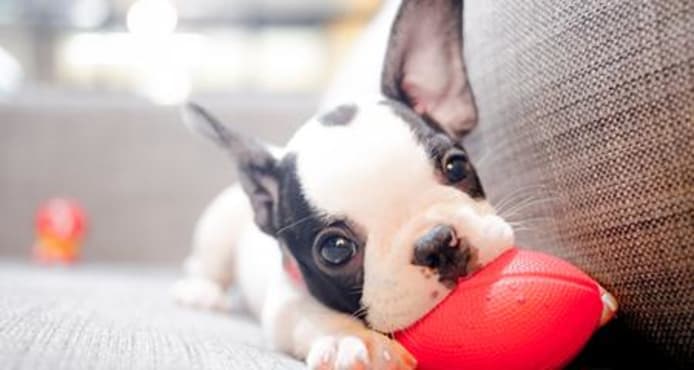
Have you ever wondered about why puppies are born with their eyelids closed?
Have you ever wondered about why puppies are born with their eyelids closed? Find out more about eye development and eyesight in puppies and adult dogs.
Eye Development in Puppies
All puppies are born with their eyelids closed. The lids are closed because the eyes are still developing and bright light can damage to the sensitive tissues. The eyelids remain closed until the newborn puppy reaches 10 to 14 days of age. At this time, the lids open exposing the still immature eyeball. The eyeball at 14 days of age is bluish to gray in color. The iris, or colored portion of the eyeball, gives the eye this bluish appearance. Additionally, the cornea may appear hazy or not transparent. The iris will take on the adult coloration usually by eight weeks of age, but some breeds may take longer. The cornea will normally become clear by eight weeks of age also.
When pups first open their eyes, they can only see movement and shapes. The good news is that a puppy's vision will improve dramatically over the following weeks and should have adequate vision by eight weeks of age. An eight week old pup's vision should be as acute as an adult dog's vision.
How Puppy Vision Is Assessed
Visual evaluation can be assessed by silently tossing cotton balls into the air and observing the puppy's visual response. The normal puppy should follow the hand motion then watch the cotton ball as it moves through the air and falls to the floor. It is important to make no sound as the puppy may respond to the noise rather than the visual stimuli. This vision test can also be used to assess the vision of adult dogs.
Do Dogs See Colors?
It is a myth that dogs only see black and white. While dogs cannot see every color of the rainbow as humans do, they can see shades of certain colors. It is thought that dogs can see shades of blue, yellow, green, and grayish brown. Humans also have the advantage in seeing fine details, but dogs can definitely see better in dim light as well as perceiving movement.
Puppy Eye Development: Week-by-Week Visual Milestones
| Age | Eyelid Status | Eye Appearance | Vision Capability |
|---|---|---|---|
| Birth – 10 days | Fully sealed shut | Not visible | None — eyelids protect developing ocular tissue from light damage |
| 10 – 14 days | Eyelids begin to open | Bluish-gray iris; cornea appears hazy or cloudy | Minimal — light perception only |
| 2 – 3 weeks | Eyes fully open | Iris still blue-gray; cornea clearing gradually | Limited — detects gross movement and large shapes only |
| 3 – 5 weeks | Fully open | Iris color transitioning toward adult pigmentation | Improving — tracks moving objects; depth perception developing |
| 6 – 7 weeks | Fully open | Cornea typically clear; iris approaching adult color | Functional — responds reliably to visual cues including the cotton-ball test |
| 8 weeks | Fully open | Adult iris coloration present in most breeds; cornea clear | Adequate — vision considered comparable to a healthy adult dog's acuity |
| 8 – 16 weeks | Fully open | Some breeds may continue iris pigmentation changes | Fully functional; color perception limited to blues, yellows and grayish-browns |
A note on breed variation: Some breeds take longer than eight weeks to reach full iris pigmentation — this is normal. If your puppy's eyes appear cloudy, red or discharge-producing beyond three weeks of age, consult your veterinarian promptly, as early intervention matters for ocular health.
Frequently Asked Questions
When do puppies first open their eyes? Puppies are born with their eyelids sealed shut to protect the still-developing tissues from light damage. The eyelids typically open between 10 and 14 days of age, revealing an immature eyeball that appears bluish to gray.
Why do puppies have blue eyes when they first open them? That blue-gray color comes from the iris, which hasn't yet produced its full adult pigmentation. The cornea may also look hazy or cloudy at this stage — both are completely normal parts of development, not signs of a problem.
When do puppy eyes change to their permanent color? In most puppies, the iris reaches its adult coloration by around eight weeks of age, though some breeds may take a little longer. The cornea typically clears up on the same timeline. If your puppy's eyes still look cloudy or blue well past eight weeks, check in with your veterinarian.
When can puppies see clearly? When pups first open their eyes at 10–14 days, they can detect only movement and basic shapes. Vision improves rapidly over the following weeks, and by eight weeks of age a puppy's eyesight should be roughly as sharp as an adult dog's.
Can dogs see color, or only black and white? Dogs are not colorblind in the black-and-white sense — that's a common myth. They can perceive shades of blue, yellow, green and grayish brown, though their color range is narrower than a human's. Dogs do have a clear edge over people when it comes to seeing in dim light and detecting motion.
How can I tell if my puppy's vision is developing normally? A simple at-home check: silently toss a cotton ball into the air and watch whether your puppy tracks it with his eyes as it moves and falls. Make no noise during the test — you want to confirm a visual response, not a sound response. If your puppy doesn't follow the cotton ball by eight weeks, consult your veterinarian for a thorough evaluation.
This article was created with assistance from AI tools and reviewed for accuracy by Petco's content team.
111Pet Parents found this article helpful


