


Two Easy Ways to Start Earning Rewards!
Become a member today! Members-only pricing and offers, personalized care notifications, Vital Care points back on every purchase and more!
 Become a credit card member today!
Earn 2X Pals Rewards points at Petco
when you use Petco Pay!APPLY NOWLearn More About Petco Pay Benefits
How to Stop a Dog From Jumping on People
Published on January 24th, 2023
Updated on June 18th, 2026

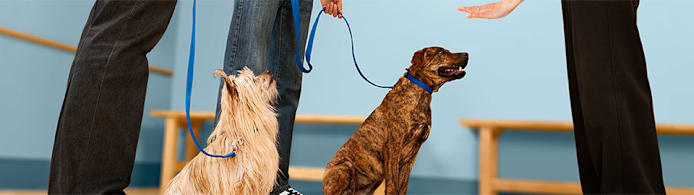
Learn tips from Petco positive dog trainers on how to train your dog not to jump up on you or other people.
We love when our dogs get excited to see us, and it’s equally as adorable when they’re excited to greet our guests. What’s not so exciting, though, is the habit that many dogs get of jumping on guests when they arrive. While it may seem harmless and even a little cute when your puppy is jumping for joy at you when you arrive home, this behavior will soon become less adorable as your puppy grows up in age—and size. Since jumping up on you and your visitors will soon become an annoyance, and possibly even dangerous with some large breeds, it’s best to train your dog to not partake in this behavior from puppyhood.
Why do puppies jump?
Before you begin training, consider why puppies jump in the first place. “Our trainers get asked questions daily on how to curb very specific, undesired behaviors like barking, pulling on a leash and, of course, jumping,” notes Darris Cooper, CPDT-KA, and the instructor at Petco’s Dog Training Mentor University. “When you think about the act of a dog jumping on a person, it can happen for many reasons. Nine times out of 10, your pup is just super excited to see their favorite person.”
Some of the main reasons a puppy usually jumps include:
- They are greeting their favorite people
- They are very excited
- The jumping behavior has somehow been reinforced, or not deterred, in the past
How to stop a dog from jumping
How to Stop Your Dog From Jumping: Four Proven Steps
Teaching your dog not to jump on people is more achievable than it might feel in the moment — and with the right approach, most dogs pick it up quickly. Work through these four steps consistently, and you'll give your dog a clear picture of exactly what you want from him.
Step 1: Turn Away the Moment He Jumps
The instant your dog jumps — whether on you or a guest — turn your back to him completely. Cross your arms, avoid eye contact, and say nothing. No "no," no pushing him down, no knee to the chest. Any physical or verbal reaction, even a frustrated one, counts as attention, and attention is exactly what he's after.
Stay turned away until all four paws are back on the floor. Silence and stillness are your most powerful tools here.
Step 2: Ask for a "Sit" Before Re-Engaging
Once your dog has settled, turn back around and calmly ask him to sit. If he jumps again the moment you face him, repeat Step 1 immediately. The pattern — jump → you turn away, four paws down → you return and ask for a sit — teaches him that jumping makes you disappear, while keeping calm brings your attention back.
Be patient. Some dogs need dozens of repetitions before the lesson clicks. That's completely normal.
Step 3: Manage His Environment to Set Him Up for Success
Management means arranging situations so your dog simply can't rehearse the jumping behavior while he's still learning. The more he practices jumping, the more ingrained the habit becomes — so prevention matters as much as training.
Practical management strategies include:
- Leashing your dog when guests arrive so you can guide him into a sit before greetings begin
- Using a baby gate or exercise pen to keep him in a separate area until he's calm
- Asking visitors to wait before entering until your dog is settled
- Giving him a pre-arrival outlet — a short walk or play session burns off the burst of excitement that fuels jumping in the first place
Pair consistent management with regular training sessions and adequate daily exercise. A dog who has had a chance to burn energy is far easier to redirect than one who is wound up and ready to launch.
Step 4: Reward Four Paws on the Floor — Every Time
Positive reinforcement is the engine that drives lasting behavior change. The moment your dog keeps all four paws on the ground when someone new arrives — or offers a calm sit or a down on his own — mark it with a cheerful "yes!" and follow it with a reward immediately.
It's easy to focus on what your dog is doing wrong. Make a conscious effort to catch him doing things right. Every time you reward a calm greeting, you're making that behavior more likely to happen again.
A few tips for effective rewarding:
- Timing matters: Deliver the reward within one to two seconds of the desired behavior so he connects the dots
- Keep treats small: Pea-sized pieces are plenty — you want him motivated, not full
- Vary the reward: Praise, a favorite toy, or a wholesome treat all count; mixing them up keeps him engaged
- Reward every person: Ask guests to participate — a dog who learns that everyone ignores jumping and everyone rewards calm behavior generalizes the lesson much faster
Consistency Is Everything
With patience and persistence, virtually any dog can learn to greet people politely. The key is that every person in your household — and every visitor you can brief — responds the same way, every single time. One enthusiastic "it's okay, I don't mind!" from a guest can undo a week of solid training.
If you've worked through these steps and feel like you could use a little extra support, consider booking a positive reinforcement dog training class at your local Petco. A knowledgeable trainer can observe your dog's specific behavior and help you fine-tune your approach.
Training Method Comparison: How to Stop a Dog From Jumping on People
Use this quick-reference table to choose the right response in the moment — and avoid the common mistakes that accidentally reinforce jumping behavior.
| Situation | What TO Do | What NOT to Do | Why It Matters |
|---|---|---|---|
| Dog jumps when you walk in the door | Turn your back silently; wait for four paws on the floor | Push the dog down, knee the dog, or say "no" loudly | Any physical or verbal reaction — even negative — can reward attention-seeking behavior |
| Dog jumps on a guest | Ask the guest to turn away and cross their arms; reward the dog the moment he sits | Let guests pet or laugh at the jumping dog | Inconsistent responses from different people slow training significantly |
| Dog is mid-jump | Say "sit" calmly once all four paws land; reward immediately with a treat or calm praise | Repeat "sit" multiple times while the dog is still jumping | Cues given mid-jump are rarely heard; waiting for stillness sets the dog up for success |
| Dog keeps jumping despite ignoring | Redirect to an incompatible behavior (sit, place, down) before the jump starts | Yell, shove, or use punishment-based tools | Positive reinforcement of an alternate behavior is more durable than suppression alone |
| High-excitement arrivals (after long absence) | Practice calm arrivals; step outside and re-enter repeatedly until the dog stays calm | Greet the dog with big, excited energy that escalates arousal | Your own energy directly influences your dog's arousal level |
| Puppy jumping (under 6 months) | Begin four-on-the-floor training immediately; reward every calm greeting | Wait until the dog is "older" to address it | Habits formed in puppyhood are significantly harder to undo in adulthood |
| Management between training sessions | Use a leash, baby gate, or ex pen to prevent rehearsal of jumping | Allow free rehearsal of jumping because "he's still learning" | Every unreinforced repetition of jumping strengthens the habit |
| Progress feels slow | Stay consistent; enlist every household member and frequent visitors | Give up and allow jumping "just this once" | A single inconsistent reward can reset weeks of progress |
Key rule of thumb: If your dog gets any reaction — a look, a touch, a word — jumping has been rewarded. Silence and stillness are your most powerful tools until four paws are on the floor.
This article was created with assistance from AI tools and reviewed for accuracy by Petco's content team.
Related Articles


