


Two Easy Ways to Start Earning Rewards!
Become a member today! Members-only pricing and offers, personalized care notifications, Vital Care points back on every purchase and more!
 Become a credit card member today!
Earn 2X Pals Rewards points at Petco
when you use Petco Pay!APPLY NOWLearn More About Petco Pay Benefits
Dog Show Categories, Groups & Key Terminology
Published on November 4th, 2024
Updated on June 18th, 2026

Written by Petco Editorial Team
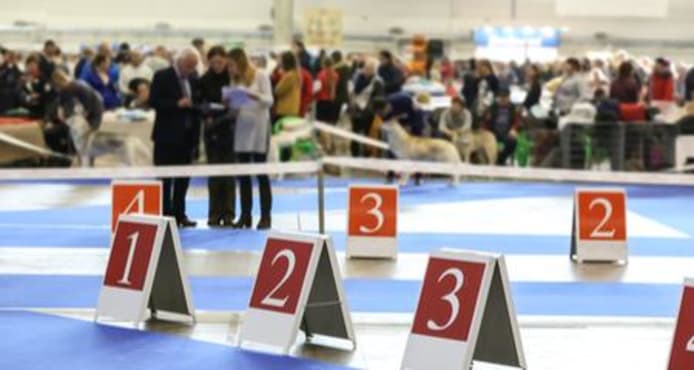
Dog shows have their own unique set of rules and terminology. The following is a helpful list of terms associated with the sport.
Dog Show Categories, Classes & Key Terminology
Whether you're watching the Westminster Kennel Club Dog Show for the first time or planning to enter your dog in a local conformation event, understanding how dog shows are structured — and the language used inside the ring — makes the whole experience click. Below is a comprehensive guide to dog show categories, competition classes, awards, and the essential terms every dog fancier should know.
How Dog Shows Are Organized: The Big Picture
Dog shows are not a single competition — they're a layered series of categories, each with its own judging criteria. At the broadest level, dogs compete within their breed, then advance to group competition, and finally to Best in Show. Understanding this structure is the fastest way to follow along on show day.
The Seven AKC Dog Show Groups
Every breed recognized by the American Kennel Club (AKC) belongs to one of seven groups. Group competition is one of the most exciting dog show categories to watch, because it pits the best representative of each breed against one another. Here's what each group represents:
| Group | Purpose & History |
|---|---|
| Sporting | Developed to assist hunters in finding and retrieving feathered game; includes retrievers, spaniels and pointers |
| Hound | Used for hunting by sight (sighthounds) or scent (scenthounds); includes Beagles, Greyhounds and Bloodhounds |
| Working | Bred to pull carts, guard property and perform search-and-rescue work; includes Boxers, Great Danes and Siberian Huskies |
| Terrier | Originally bred to hunt and eliminate vermin; tenacious, energetic and often feisty |
| Toy | Distinguished primarily by very small size; bred as companions |
| Non-Sporting | A diverse group of multi-functional dogs not generally regarded as game hunters; includes Bulldogs, Poodles and Dalmatians |
| Herding | Bred to drive livestock from one place to another; includes Border Collies, Australian Shepherds and Corgis |
A dog must win its breed competition before it can advance to group judging. The group winner then moves on to compete for Best in Show.
Types of Dog Shows
Not every show works the same way. Knowing the format helps you set the right expectations — whether you're attending as a spectator or entering your dog.
Conformation Dog Show The most common format. An event held under club rules where championship points are awarded. The purpose is to allow breeders to evaluate the success of their breeding program, with the goal of achieving the structure and temperament necessary for the breed's function and to evaluate dogs for use as future breeding stock. Judging is always a comparison of each dog against the official breed standard — not dog against dog.
Bench Show A bench show is a dog show at which dogs are kept on assigned benches when not being shown in competition, so they can be viewed and discussed by attendees, exhibitors and breeders. Bench shows are relatively rare today but offer a uniquely interactive experience for dog lovers.
Match Show Usually an informal dog show at which no championship points are awarded. Match shows are excellent low-pressure starting points for new exhibitors and young dogs learning the ring environment.
Field Trial A competition for certain Hound or Sporting breeds in which dogs are judged on their ability and style in finding or retrieving game or following a game trail. Field trials evaluate working instinct rather than physical conformation.
Competition Classes Explained
Within a conformation show, dogs first compete in regular classes against others of the same breed and sex. The winners of each class then compete for Winners Dog and Winners Bitch — the only dogs awarded championship points that day.
| Class | Who Is Eligible |
|---|---|
| Bred-by-Exhibitor | Dogs owned or co-owned by one of the breeders and shown by one of the breeders on record |
| Junior Showmanship | Handlers between the ages of 9 and 18, judged on handling skill — not the dog's conformation quality |
| Miscellaneous Class | A transitional class for breeds working toward full club recognition |
Awards: From Winners to Best in Show
The award structure in dog shows follows a clear progression. Here's how it works from the breed level up:
Winners Dog / Winners Bitch The award given to the best male (Winners Dog) and best female (Winners Bitch) competing in regular classes. These are the only dogs of that breed who earn championship points on that day. In dog show terminology, "dog" refers specifically to a male canine, and "bitch" is the correct, standard term for a female canine.
Best of Winners The single dog judged as best between the Winners Dog and the Winners Bitch.
Best of Breed The award for the dog judged as the best representative of its breed overall — including champions already holding that title.
Best of Variety An award given in place of Best of Breed for the nine breeds that are officially divided into varieties: Cocker Spaniels, Beagles, Dachshunds, Bull Terriers, Manchester Terriers, Chihuahuas, English Toy Spaniels, Poodles and Collies.
Best of Opposite Sex The best dog of the opposite sex to the Best of Breed winner.
Champion A title conferred upon a dog that has earned 15 points in competition by defeating a specified number of dogs across a series of shows. Points credits earned toward a championship are called — simply — points.
Essential Dog Show Terms: A–Z Reference
Angulation The angles created by bones meeting at their joints. Correct angulation is a key element judges evaluate when assessing a dog's structure and movement.
Bait Food or an object the handler uses to focus the dog's attention or encourage an alert, engaged expression in the ring. Bait is a practical handling tool, not a training shortcut.
Breed Standard The official written description of the ideal dog of each recognized breed, as specified by the breed's parent club. The breed standard covers structure, form, movement, coat and temperament — and it is the sole benchmark against which every dog in a conformation show is judged.
Breeder The person who owned the dam (mother) at the time she was bred to produce a particular dog.
Breeder-Owner-Handler Someone who exhibits, owns and handles the dog they bred — a combination that carries its own prestige in the sport.
Champion (see Awards section above)
Conformation The form, structure, shape and arrangement of the parts of a dog as they relate to the written standard of the breed. Conformation is the central concept of the sport.
Exhibitor Any person whose dog is entered and shown at a dog show.
Expression The general appearance of all features of the head as a unified whole — eyes, ears, muzzle and skull shape together create a breed's distinctive expression.
Fancy The collective term for the community of people especially interested in purebred dogs or a specific breed. Fanciers are typically active participants in the sport.
Feathering The longer fringe hair found on a dog's ears, tail or body — a coat characteristic evaluated as part of breed type in many Sporting and Hound breeds.
Gait The pattern of movement of the dog — described as a gallop, trot, walk or hackney action. Gait is a reliable indicator of structure, temperament and overall condition, and is almost always evaluated at a trot in the show ring.
Grooming The practice of preparing a dog's appearance to adhere to the breed standard through bathing, brushing, combing, trimming and other techniques. Presentation matters — but it must serve the standard, not disguise faults.
Handler The person who takes a dog into the show ring or works the dog at a field trial or other performance event. A professional handler is a person who shows dogs for a fee.
Junior Handler A person between the ages of 9 and 18 who competes in a club-sponsored Junior Showmanship class. Junior handlers are judged entirely on their ability to present and handle their dog — the dog's conformation quality is not a factor.
Miscellaneous Class (see Competition Classes above)
Pedigree A written record of a dog's family tree spanning three or more generations.
Purebred A dog whose sire (father) and dam (mother) belong to the same breed and are themselves of unmixed descent since the recognition of that breed.
Register To record a dog's parentage with the governing club — a foundational step for any dog entering the sport.
Soundness The mental and physical well-being of the dog. A sound dog is free from structural defects and behavioral instability that would interfere with its ability to perform the function for which it was bred.
Stack To position the dog in a natural standing pose so the judge can observe its conformation clearly. Stacking is a practiced skill for both handler and dog.
Type The characteristic qualities that distinguish one breed from all others. Type is what makes a Basset Hound look unmistakably like a Basset Hound.
Quick-Reference: Dog Show Award Progression
``` Individual Classes (by breed & sex) ↓ Winners Dog + Winners Bitch (championship points awarded here) ↓ Best of Winners ↓ Best of Breed / Best of Variety ↓ Group Competition (one of seven groups) ↓ Best in Show ```
Ready to Learn More?
The best way to absorb dog show terminology is to watch a show live — or stream one — and listen for every term covered here. You'll be surprised how quickly the structure becomes second nature. If your interest in dog shows has you thinking more carefully about your dog's nutrition and condition, explore wholesome dry dog food options and dog treats that can help support the energy and coat condition a show dog — or any dog — deserves.
AKC Dog Show Groups at a Glance
Understanding how the American Kennel Club organizes breeds into groups is one of the fastest ways to follow along at any conformation dog show. After each breed competes for Best of Breed, the winners advance to Group judging — where one dog from each of the seven groups is selected before the Best in Show round begins. Here's a breakdown of every group, what defines it, and a few well-known breeds you'll recognize in the ring.
| Group | Original Purpose | What to Watch For in the Ring | Example Breeds |
|---|---|---|---|
| Sporting | Developed to assist hunters in locating and retrieving feathered game | Athletic build, eager gait, dense or water-resistant coat; often shown with a lively, alert expression | Labrador Retriever, Golden Retriever, Cocker Spaniel, Irish Setter |
| Hound | Used for hunting by acute scent or sharp sight | Judges evaluate stamina, scenting ability (Scent Hounds) or lean, aerodynamic build (Sighthounds); wide variety of sizes | Beagle, Greyhound, Bloodhound, Rhodesian Ridgeback |
| Working | Bred to pull carts, guard property, and perform search and rescue | Large, powerful frames; judges look for strength, endurance, and steady temperament | Boxer, Doberman Pinscher, Great Dane, Siberian Husky |
| Terrier | Originally used to hunt and control vermin | Feisty, confident movement; wiry or dense coats; judges reward boldness and a characteristic "terrier attitude" | Scottish Terrier, Bull Terrier, Airedale Terrier, Jack Russell Terrier |
| Toy | Characterized by very small size; bred primarily for companionship | Compact proportions judged against precise breed standards; big personality in a small package | Chihuahua, Maltese, Pomeranian, Shih Tzu |
| Non-Sporting | Diverse, multi-functional dogs not generally regarded as game hunters | Highly varied in size, coat, and structure — this group rewards each breed's unique standard rather than a shared working trait | Bulldog, Dalmatian, Poodle (Standard & Miniature), Chow Chow |
| Herding | Bred to drive livestock from one place to another | Judges look for agility, responsiveness, and the controlled, purposeful movement that reflects a dog's instinct to manage a flock | Border Collie, German Shepherd Dog, Australian Shepherd, Pembroke Welsh Corgi |
Pro tip for first-time spectators: Pick one group that interests you and watch the entire judging sequence from breed level through Group judging. You'll see how the handler stacks each dog, how the judge evaluates gait, and how breed standard shapes every decision in the ring.
Frequently Asked Questions
How many groups are there in AKC conformation dog shows? There are seven AKC groups: Sporting, Hound, Working, Terrier, Toy, Non-Sporting, and Herding. Every AKC-recognized breed belongs to exactly one group, and group winners advance to compete for Best in Show.
What is the difference between Winners Dog, Best of Winners, and Best of Breed? Winners Dog and Winners Bitch are the top unaltered male and female in their breed's regular classes — they are the only dogs awarded championship points that day. Best of Winners is then selected between those two. Best of Breed is the single dog judged the finest representative of the entire breed, which may include already-titled Champions competing in the Open class.
How does a dog earn a Champion title? A dog must accumulate 15 points by defeating a specified number of dogs at AKC-licensed shows. Those points must include at least two "major" wins (shows where three or more points are awarded), earned under at least two different judges.
What does "breed standard" mean, and who writes it? A breed standard is the official written description of the ideal specimen of a recognized breed — covering structure, movement, coat, temperament, and expression. Each breed's parent club authors the standard, and judges use it as the benchmark for every dog they evaluate in the ring.
What is a bench show, and are they common today? A bench show requires dogs to remain on assigned benches between their classes so the public, exhibitors, and breeders can view and discuss them. Bench shows were once widespread but are now relatively rare in the United States; the Westminster Kennel Club Dog Show is among the most prominent events that still uses this format.
Can mixed-breed dogs compete in AKC conformation shows? Standard AKC conformation (breed group) competition is limited to purebred, AKC-registered dogs. However, mixed-breed and unregistered dogs can participate in AKC performance events such as agility, rally, and obedience through the AKC Canine Partners program.
Frequently Asked Questions
What are the main dog show categories? Dog shows are organized around several competition categories: conformation (where dogs are evaluated against their breed standard), Junior Showmanship (where handlers ages 9–18 are judged on handling skill), field trials (where Sporting and Hound breeds demonstrate hunting ability), and match shows (informal events with no championship points awarded). The conformation category is the most widely recognized and is the pathway to a championship title.
How are dogs grouped in shows? All breeds recognized by the governing club are divided into seven Groups: Sporting, Hound, Working, Terrier, Toy, Non-Sporting and Herding. Each Group winner then competes for Best in Show. The Groups are organized by the original purpose or function for which each breed was developed — for example, Herding dogs were bred to drive livestock, while Terriers were originally used to hunt vermin.
What does it take for a dog to become a Champion? A dog must earn 15 points in competition by defeating a specified number of dogs across a series of conformation dog shows. Only the Winners Dog and Winners Bitch in each breed earn championship points on a given show day.
What is the difference between Best of Breed and Best of Winners? Best of Breed is awarded to the dog judged as the finest representative of its entire breed that day, including already-titled Champions. Best of Winners is a separate award given to whichever dog — Winners Dog or Winners Bitch — is judged superior between the two. The Best of Winners award can affect the number of championship points a dog receives.
What is a breed standard, and why does it matter? A breed standard is the official written description of the ideal specimen of a recognized breed, authored by that breed's parent club. It covers structure, movement, coat, temperament and the physical traits that allow the breed to perform the function for which it was originally developed. All conformation judging is a comparison of individual dogs against this established standard — not a comparison of dogs against each other.
Can a mixed-breed dog compete in a conformation dog show? Traditional conformation dog shows require dogs to be purebred — meaning the sire and dam belong to the same breed and are of unmixed descent since the breed's recognition. Mixed-breed dogs are not eligible for conformation competition or championship points, though they may participate in other performance and companion events offered by various clubs.
This article was created with assistance from AI tools and reviewed for accuracy by Petco's content team.
15Pet Parents found this article helpful


