


Two Easy Ways to Start Earning Rewards!
Become a member today! Members-only pricing and offers, personalized care notifications, Vital Care points back on every purchase and more!
 Become a credit card member today!
Earn 2X Pals Rewards points at Petco
when you use Petco Pay!APPLY NOWLearn More About Petco Pay Benefits
St. Bernard Breed Facts and Information
Updated on June 17th, 2025




Temperament
Gentle, loyal, patient
Coat Color
Brown & White
 Weight
120 - 140 Pounds
 Height
28 - 30 Inches
 Life Expectancy
8 - 10 Years
Maintenance Level
Low Maintenance
High Maintenance
Personality
Reserved
Extroverted
About Saint Bernards
St. Bernards hail from the Western Alps, a region encompassing parts of France, Switzerland, and Italy. Their lineage can be traced back to the ancient molosser dogs first brought into the region by the Romans. They became famous for their work as rescue dogs for the monks at the hospice of the St. Bernard passes, an inhospitable mountain region. The modern St. Bernard is a true “gentle giant”, a patient and good-natured companion for families around the world.
Origin: Switzerland, France, Italy Other Names: Saint, Alpine Mastiff
Working Group
Dogs of the Working Group were bred to perform such jobs as guarding property, pulling sleds and performing water rescues. Working Group dogs have been invaluable assets to man throughout the ages. Quick to learn, these intelligent, capable animals make solid companions. Their considerable dimensions and strength alone, however, make many working dogs unsuitable as pets for average families. And again, by virtue of their size alone, these dogs must be properly trained.
Saint Bernard Appearance
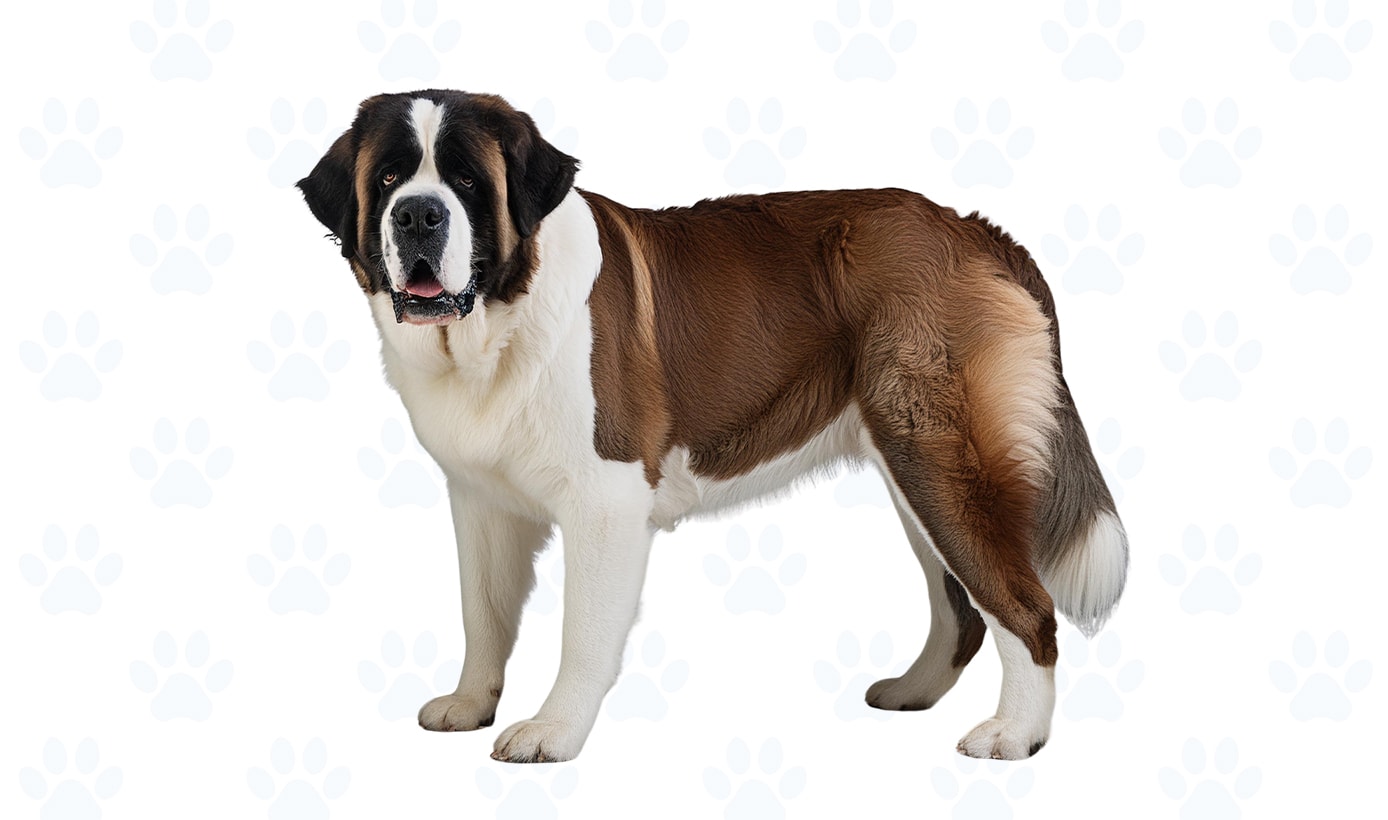
St. Bernards are tall and muscular. They have an intelligent, kind expression, large triangular ears that hang down beside the head, and a broad nose. Their neck, shoulders, and legs are robust and powerfully built.
The AKC recognizes nine standard St. Bernard colors: brindle grizzle, brown and white, mahogany and white, orange and white, red and white, rust and white, white and brown, white and orange, and white and red. The black mask on the face is considered standard. St. Bernards can have short or medium length hair, with a coat that is always dense but never curly.
Size & Weight
Male St. Bernards weigh between 140 and 180 pounds, and stand 27 to 30 inches tall at the shoulders. Females are slightly smaller, weighing in between 120 to 140 pounds and 26 to 28 inches tall at the shoulders.
Full Grown
Female
28 in. / 120 lbs.
Male
30 in. / 140 lbs.
Height is measured up to the shoulders.
Characteristics
- Size & Coat
- Lifestyle
- Training & Behavior
How to Care for a Saint Bernard
When they are young, St. Bernards need a structured environment and an owner who is not afraid to step up to take command of a situation. They can be somewhat stubborn, so consistent training is essential. If they are left to their own devices, their strength and size can make them a real handful. St. Bernards can become morose and destructive if they are left alone for long periods of time, and they can do serious damage to your home. St. Bernards are best suited for owners who have plenty of time to spend with them and enough energy to deal with their youthful rambunctiousness.
Cost of Owning
Savings & Rewards
Unlock exclusive rewards with Petco Perks. Plus, members get 35% off their first Autoship order and 5% off all future orders.

Enjoy exclusive rewards on expert rated and pet parent approved products, like member prices, extra points and special offers designed to help you save on what your pet needs.

Get your pet’s essentials delivered on your schedule so you never run out and save up to 35% on your first order, then 5% on every order after that.
Your love story starts here.
Find adoptable pets near you with a simple search.
Fun Facts
One legendary St. Bernard, Barry, was said to have rescued more than 40 people in and around the St. Bernard Pass.
An 1895 edition of the New York Times describes a St. Bernard dog named Major as measuring 8 feet 6 inches in length. If this was accurate, he would have been the longest dog in history.
The movies “Beethoven” and “Beethoven’s 2nd” tell the story of a large, clumsy, but lovable St. Bernard.
History
St. Bernards are the descendents of large farm dogs in the Western Alps. It is thought that the Romans first introduced these dogs into the region. The first written records of the St. Bernard come from the monks at the hospice of the Greater St. Bernard Pass in the early 1700’s. The monks used this special breed of dogs for locating travelers lost in the pass during snowstorms. These older St. Bernards were smaller than the St. Bernards of modern times.
During a few particularly harsh winters in the 19th century, many of the original St. Bernards were lost to avalanches, so the remaining animals were crossbred with Newfoundland dogs in an attempt to preserve the lineage. This resulted in a larger dog with a longer coat that would become frozen in the snow, making them less useful in rescue operations.
The Swiss St. Bernard Club was founded in 1844. The breed soon became recognized as a Swiss national dog. Around 1883, a St. Bernard named Plinlimmon, owned by a famous actor of the day, was the first St. Bernard to become well known in America. The American Kennel Club first recognized the breed in 1885.