


Two Easy Ways to Start Earning Rewards!
Become a member today! Members-only pricing and offers, personalized care notifications, Vital Care points back on every purchase and more!
 Become a credit card member today!
Earn 2X Pals Rewards points at Petco
when you use Petco Pay!APPLY NOWLearn More About Petco Pay Benefits
How Cats Communicate With Each Other & With You
Published on November 1st, 2024
Updated on June 18th, 2026

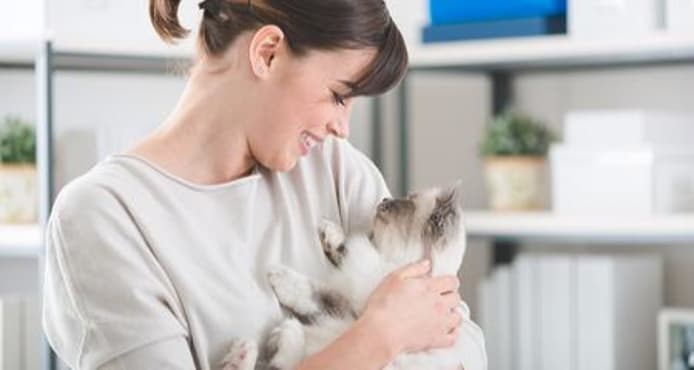
As natural observers, cats understand us much better than we understand them, but that doesn’t mean reading them is impossible. Here are six common ways cats try to communicate with us.
How Cats Communicate With Each Other — and With You
Cats have a reputation for being mysterious, and honestly, they've earned it. Unlike dogs, who wear their emotions on their sleeves (and their tails), cats rely on a layered, nuanced communication system built from sound, body language, scent and eye contact. Here's what makes feline communication especially fascinating: most of it isn't aimed at us at all. Cats developed the majority of their signals to talk to each other — and understanding that cat-to-cat vocabulary is the key to finally understanding your cat.
1. Purring — A Comfort Signal Cats Share With Each Other and With You
Most of us read purring as a simple "I'm happy" signal, but it's more accurate to understand it as your cat saying "please stay close." Cats purr with other cats they trust — littermates, bonded companions and familiar colony members — as a way of maintaining closeness and signaling that they mean no harm. That same comfort-seeking behavior carries over to their relationship with you.
Purring isn't always a sign of contentment, either. Cats also purr when they are scared, sick or injured — essentially asking whoever is nearby (feline or human) to stay and provide reassurance. Think of it less as a mood indicator and more as a social bonding tool that says "I feel safe with you" or "I need you right now."
2. Meowing — A Language Cats Invented Just for Humans
Here's one of the most surprising facts in feline behavior: adult cats do not meow at each other. Kittens meow to their mothers, but once cats reach adulthood, meowing between cats essentially stops. The meow, as we know it, is a communication strategy cats developed specifically because they learned it works on humans.
That means every meow your cat directs at you is a customized signal — shaped over time by what got your attention in the past. A short, bright chirp at the food dish means something very different from a long, low yowl at 2 a.m. Because there is no universal meow dictionary, you'll need to learn your individual cat's vocabulary through observation. Pay attention to pitch, length and context, and patterns will emerge quickly.
3. Tail and Body Language — The Vocabulary Cats Use With Each Other Every Day
Body language is the primary way cats communicate with other cats, and it's remarkably expressive once you know what to look for. Tail position, ear angle, posture and fur all work together to send clear messages — messages that cats read instantly in each other and that you can learn to read too.
| Signal | What It Means |
|---|---|
| Tail held high, fur relaxed | Confident and content — a friendly greeting between cats |
| Tail held high, fur puffed out | Frightened or aggressive — a warning to back off |
| Tail low or tucked | Anxious, insecure or submissive |
| Tail lashing or thrashing | Agitated or overstimulated — give your cat space |
| Slow tail sway | Focused or mildly irritated; different from a dog's happy wag |
| Tail wrapped around another cat | Affection and social bonding between familiar cats |
When cats greet each other after a separation, a raised, relaxed tail is the feline equivalent of a friendly wave. If your cat trots toward you with its tail straight up, it's offering you the same greeting it would give a trusted companion.
4. Slow Blinking — The Feline "I Trust You"
Slow, deliberate blinking is one of the most meaningful signals in the cat-to-cat communication toolkit. In the feline world, closing your eyes in front of another individual is a profound act of trust — it signals that you don't perceive the other as a threat. Cats exchange slow blinks with bonded companions as a way of reinforcing their relationship and keeping the peace.
When your cat slow-blinks at you, he's extending that same gesture of acceptance and trust. You can return the compliment: make soft eye contact, then blink slowly and look away. Many cats will blink back, and over time this simple exchange can genuinely strengthen your bond. Research has suggested that slow blinking from humans can increase affiliative behavior in cats — but even without a study, any cat parent who has tried it will tell you it works.
5. The Arched-Back Pose — A Clear "Back Off" in Any Language
The classic Halloween silhouette — arched back, puffed tail, fur standing on end — is one of the clearest signals in the feline communication system, and it works equally well on other cats, dogs, perceived predators and well-meaning humans. This posture is called piloerection, and it serves a dual purpose: it makes the cat look larger and signals that it is prepared to defend itself.
When your cat strikes this pose, the message is unambiguous: I feel threatened, and I need space. Even if your instinct is to comfort him, the kindest response is to honor the request and give him room to calm down. Approaching a cat in this state — whether you're another cat or a human — will almost always escalate the situation.
6. Rubbing and Bunting — How Cats Claim Their People (and Each Other)
When your cat rubs against your legs or presses his forehead against you (a behavior called bunting), he's doing something cats do with each other constantly: exchanging scent to build a shared "group scent" that marks trusted companions. Cats have scent glands along their cheeks, forehead, chin and the base of their tail, and rubbing deposits pheromones that communicate "you belong to my group."
Studies of feral cat colonies show that cats rub against each other most frequently after a period of separation — a reunion ritual that re-establishes social bonds. When your cat greets you at the door after a long day and winds around your ankles, he's performing that exact same ritual. It's part territorial claim, part affectionate greeting and part social bonding — the feline equivalent of a hug.
Reading Your Cat: The Bigger Picture
The most important thing to understand about feline communication is that it evolved cat-to-cat first. Meowing aside, nearly every signal your cat uses with you — the slow blink, the raised tail, the head rub — is borrowed directly from the vocabulary cats use with each other. Learning that language makes you a better, more attuned companion.
Pay close attention to combinations of signals rather than any single cue in isolation. A cat with a high tail, relaxed ears and slow blinks is telling a very different story than one with a puffed tail, flattened ears and dilated pupils — even if both are quiet. The more fluent you become in your cat's full communication system, the easier it becomes to meet his needs before he has to ask twice.
If you notice sudden or significant changes in how your cat communicates — increased vocalization, withdrawal, unusual aggression or any signal that seems out of character — consult your veterinarian. Behavioral changes can sometimes be an early indicator of an underlying health concern https://www.vet.cornell.edu/departments-centers-and-institutes/cornell-feline-health-center/health-information.
Frequently Asked Questions
Do cats communicate differently with each other than they do with humans? Yes — and the difference is striking. Meowing is used almost exclusively to communicate with people; adult cats rarely meow at one another in the wild. Cat-to-cat communication relies far more heavily on scent marking, body posture, tail position and slow blinking. Humans, by contrast, get the full vocal treatment because cats have learned that vocalizing is the most effective way to get our attention. https://www.vet.cornell.edu/departments-centers-and-institutes/cornell-feline-health-center/health-information
Why do cats slow-blink at each other and at their pet parents? In feline social language, closing the eyes in the presence of another individual signals trust and non-aggression — essentially a peaceful "I see you and I'm not a threat." Cats extend this same gesture to the people they feel safe with. You can return the signal by softly blinking back; many cats will respond in kind. https://www.vet.cornell.edu/departments-centers-and-institutes/cornell-feline-health-center/health-information
Is purring always a sign that a cat is happy? Not always. Purring is best understood as a comfort-seeking behavior rather than a pure happiness signal. Cats also purr when they are anxious, unwell or injured — essentially asking a trusted companion to stay close and provide reassurance. If your cat is purring alongside other signs of distress (hiding, changes in appetite or unusual posture), consult your veterinarian to rule out an underlying health concern.
How do cats use scent to communicate with one another? Cats have scent glands on their cheeks, chin, flanks and the base of their tail. When a cat rubs against another cat — or against your legs — it deposits pheromones that convey identity, familiarity and social bonding. Research on feral cat colonies shows this allorubbing behavior occurs most often after individuals have been separated, functioning as a feline greeting and social re-bonding ritual.
Can a cat's tail position tell me how it feels about another cat nearby? Absolutely. A high, relaxed tail signals confidence and friendly intent — the feline equivalent of a wave hello. A puffed, low or tucked tail signals fear or submission, while a rapidly lashing tail indicates agitation. Watching tail posture during cat-to-cat introductions is one of the most reliable ways to gauge whether an interaction is going well or needs to be interrupted. https://www.vet.cornell.edu/departments-centers-and-institutes/cornell-feline-health-center/health-information
When should I talk to a veterinarian about changes in my cat's communication? Any sudden shift in your cat's typical communication patterns — increased vocalization, unusual silence, hiding, or changes in how he interacts with you or other pets — can be an early indicator of pain, illness or stress. Because cats are skilled at masking discomfort, behavioral changes are often the first clue something is wrong. When in doubt, schedule a check-up; your veterinarian is your best partner in understanding what your cat is trying to tell you. https://www.vet.cornell.edu/departments-centers-and-institutes/cornell-feline-health-center/health-information
This article was created with assistance from AI tools and reviewed for accuracy by Petco's content team.
2740Pet Parents found this article helpful


