

Two Easy Ways to Start Earning Rewards!
Become a member today! Members-only pricing and offers, personalized care notifications, Vital Care points back on every purchase and more!
 Become a credit card member today!
Earn 2X Pals Rewards points at Petco
when you use Petco Pay!APPLY NOWLearn More About Petco Pay Benefits
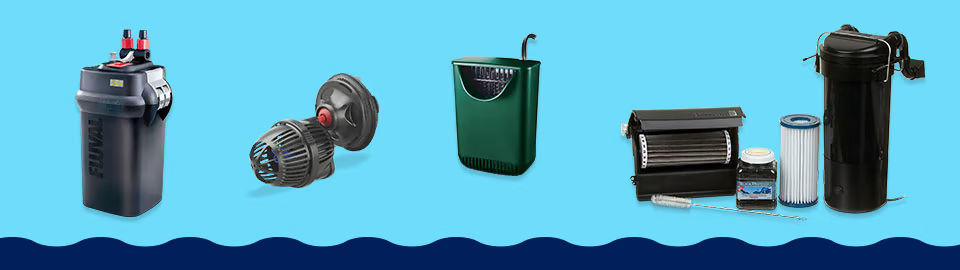
Boyd Enterprises Aquarium Filters & Media
Get It Today


Related Searches
Related Articles & Questions
- Product Guides
Aquarium Filtration: Pick the Best Filter for a Thriving Tank
Discover the fish tank filter system that’s right for your aquarium. Learn about mechanical, chemical, and biological filtration at Petco.
Updated on October 23rd, 2025
 Product Guides
Why Use a Sponge Filter? Simple & Safe Aquarium Filtration
One of the oldest forms of aquarium filtration (and not just for small tanks), a sponge filter may be the right filtration choice for your aquarium!
Updated on October 23rd, 2025
- Product Guides
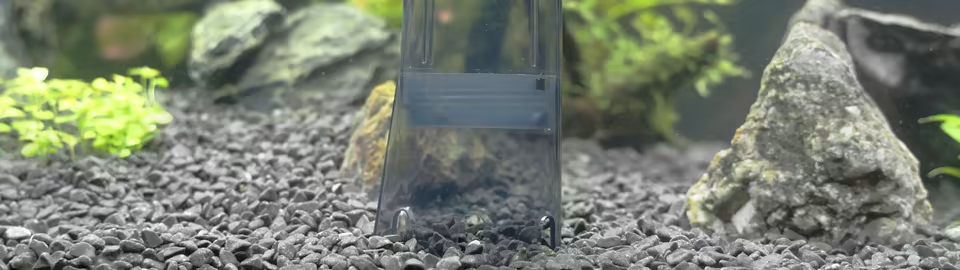
How to Gravel Vacuum: Clean Your Fish Tank for Thriving, Happy Fish
Gravel vacuuming helps remove solid waste from your substrate. Learn about the different types of gravel vacuums available & how to clean your fish tank.
Updated on October 23rd, 2025
- Home & Habitat
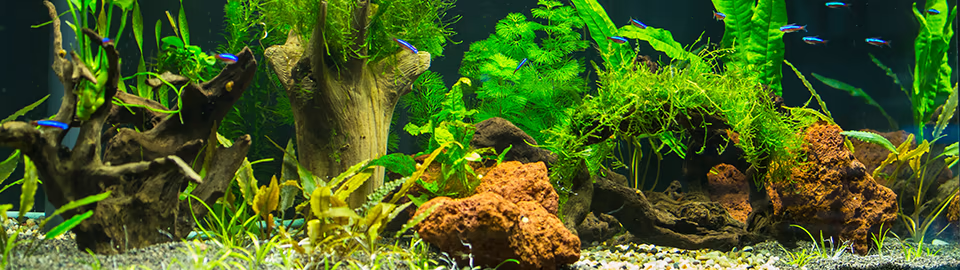
Aquarium Hardscaping: Essential for Healthy Fish & Gorgeous Aquascapes
Discover how to hardscape your aquarium here at Petco. Visit Petco and check out aquarium hardscape ideas, solutions and much more for your fish.
Updated on October 23rd, 2025
- New Pet
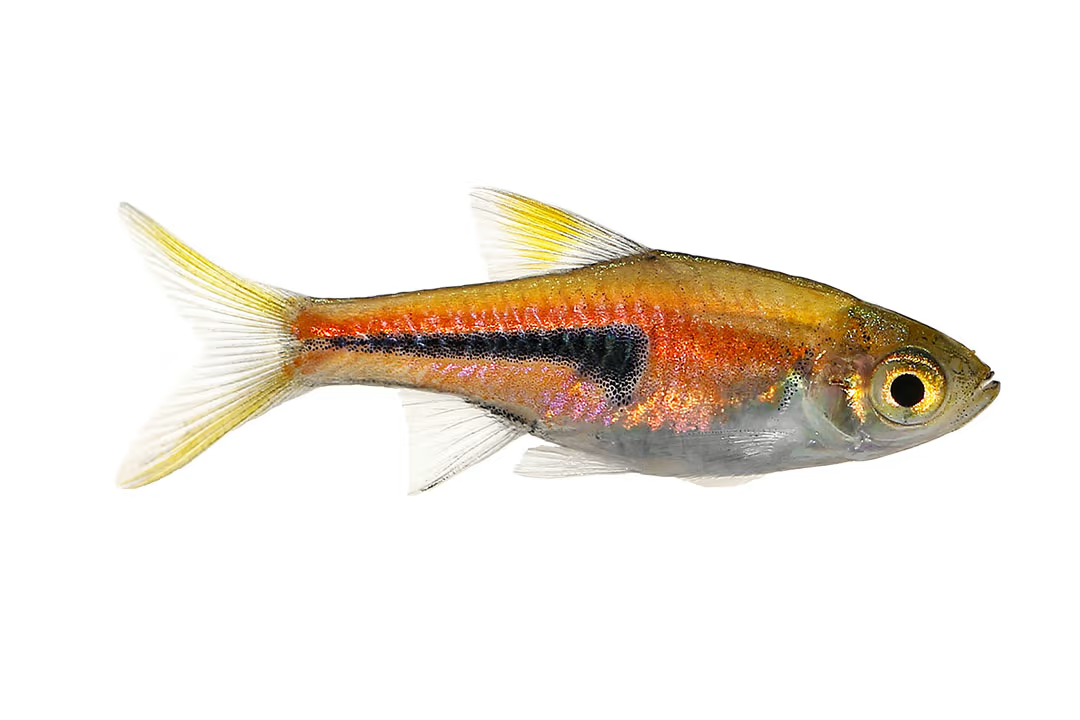
Freshwater Semi-Aggressive Fish: Top Secrets for a Thriving Tank
Learn how to care for semi-aggressive fish, recommended diet & aquarium setup. Find the right food, supplies & equipment at your neighborhood Petco.
Updated on December 21st, 2025
- Health & Wellbeing
Sir i stay in odisha whichi is in India and im getting iron in my water supply and the water that we get from the tap is very dirty. How can i treat my water so that i could make a sucessful aquarium. Please suggest me some treatments that are avalia
Some iron is necessary for a healthy aquarium, but too much can promote algae growth or impart an unsightly yellow or orange tinge to the water. Reverse osmosis (RO) filters are deal for removing mineral and heavy metals from water but they can be prohibitively expensive. Buying RO water from a local market or pet store is also a possibility but not economically feasible if you have a large tank. The best option may be a Polyfilter, which can be purchased in the local pet store or online. These filters will remove iron or other metals/chemicals and must be changed monthly or quarterly. You can also buy a water conditioner that will precipitate out some of the iron which can then be removed by mechanical filtration. An example of just one is Rid Metals (by Kordon). Follow label directions carefully, perform regular water changes and monitor iron levels with a home test kit or by submitting a water sample for testing.
Updated on September 24th, 2025
- Health & Wellbeing
Two of the fish fins are clamping down close to their body. I did 75% water change and hopefully they will get better. I do not have the water testing kit. Will buy soon. Is there any ways to get them better? I could see some of their scales are off.
Goldfish need powerful filtration. Your filter should be rated for at least twice the tank volume. Once you get a test kit, check the chemistry. Aim for 0 ppm ammonia and nitrites with nitrates at about 40ppm. Use a kit that has liquid reagents, not strips. The liquid kit is more accurate. The pH should range between 7.2-7.6. Being cold water fish, goldfish thrive between 65F and 72F. You can dissolve 1 teaspoon of plain aquarium salt (NOT table salt) per gallon of water to use as a general tonic. It will reduce stress, improve gill function, treat minor infection and aid in recovery. Treat for 10-14 days then reassess the condition of your fish. When performing partial water changes, treat only the volume of water being replaced not the entire tank volume. Change no more than 30% of the volume at a time. Use only aged or conditioned water that is temperature matched to prevent stress or shock.
Updated on September 24th, 2025
- Health & Wellbeing
My fish tank got infested with pink algae and green algae and the fish are acting lethargic and dying.
Check the water chemistry using a home test kit or submit a water sample for testing. The local Petco may do this for free or for a small fee. Aim for an absence (0 ppm) of ammonia and nitrites with nitrates at 20ppm or less. Perform partial water changes to stabilize chemistry and/or to improve water quality. Rinse the filter media in tank water, not tap water, and replace it. Use only conditioned water that is temperature matched to prevent stress or shock. To limit algae growth, maintain pristine water quality via filtration and regular water changes. If possible, turn up filter flow to keep water moving. If this stresses the fish though, do not do it. Do not overfeed and remove any uneaten food promptly. Limit lighting to 8 hours daily and closely monitor water temperature as well. All these can promote algae overgrowth.
Updated on September 24th, 2025
- Health & Wellbeing
We have added fish to our newly set up aquarium twice now and both times the fish were dead or dying within 24 hours. The pH is at the proper level. The tank was filled with spring water. Why do our fish keep dying?
It is possible the tank has not cycled properly which results in high ammonia and nitrite levels which can kill fish. Allow the tank to run, without fish, for at least 4-6 weeks. During this time, use a home test kit or submit a water sample for testing every few days. The local Petco may do this for free or for a small fee. What you are looking for is to have ammonia and nitrites at 0 ppm and nitrates at 20ppm or less. pH can hover around 7 for most community fish. Avoid large, rapid swings in pH though. What is happening in the tank during this time is that beneficial bacteria are populating the gravel/substrate and the filter. These bacterial populations are responsible for the Nitrogen Cycle. This cycle breaks down wastes from fish, uneaten food and plant matter into by-products that are filtered out or dissipate. You can "cycle" a tank with fish, however this increases the risk of loss. Once your tank has cycled, you can add fish. You will still need to monitor water chemistry a
Updated on September 24th, 2025
- Health & Wellbeing
I have basic aquarium at home, since 2 days all are not active and seen abnormal, shark, gold, koi are all having bleeding on their body without any reason i know. Suddenly at one time continuously fishes getting die, even I changed water at overnigh
I'm sorry you are having difficulties with your aquarium. There are several issues that should be dealt with right now. They are water chemistry, aquarium size and choice/number of fish. Any new aquarium should be set up and, ideally, run empty for several weeks (usually 4-6 weeks). This is so beneficial bacteria have an opportunity to populate the substrate and filter. These bacteria are necessary to break down wastes that fish will produce. The technical phrase for this is "establishing the Nitrogen cycle". These bacteria will break down wastes into ammonia then nitrites then nitrates. Nitrates can then dissipate or be absorbed/used by live plants. In high enough concentrations, ammonia and nitrites are toxic and can kill fish. Cycling a tank with fish is possible but it increases the risk of loss. Water chemistry should be checked every few days using a liquid home test kit. A water sample can be submitted for testing , but is not as convenient as testing yourself. Most pet sto
Updated on September 24th, 2025