


Two Easy Ways to Start Earning Rewards!
Become a member today! Members-only pricing and offers, personalized care notifications, Vital Care points back on every purchase and more!
 Become a credit card member today!
Earn 2X Pals Rewards points at Petco
when you use Petco Pay!APPLY NOWLearn More About Petco Pay Benefits
Vampire Crab Care Sheet
Published on May 3rd, 2026
Updated on June 30th, 2026

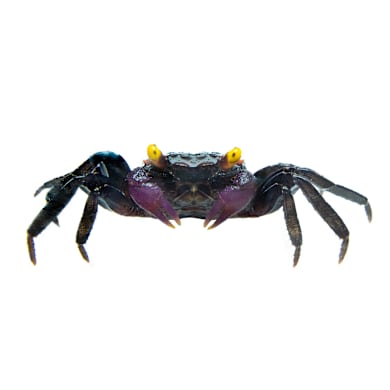
Learn how to care for your new Vampire crab.
This care sheet covers the vampire crabs:
Geosesarma rouxi
Geosesarma bicolor
Geosesarma dennerle
Geosesarma tiomanicum
Geosesarma hagen
Geosesarma spp.
Overview
Vampire crabs obtained their nickname from their nocturnal habits and vampire like appearance. This small, semi-terrestrial species of crab is native to freshwater environments of Southeast Asia, with many found in Indonesia. Vampire crabs have an enlarged gill chambers to retain moisture, supporting prolonged air exposure, allowing for them to spend more time on land.
Typical vampire crab appearance and behavior
· Wide range of color palettes
· Bright/glowing-colored eyes
· Square-shaped carapace
· Shy
· Territorial between males
· Nocturnal
· Social
· Males have large claws, females are smaller
Characteristics
| Care difficulty | Beginner |
|---|---|
| Average life span | Up to 2.5 years when properly cared for |
| Average adult size | Up to 2” |
| Diet | Omnivore |
| Minimum habitat size | 2.5+ gallons |
| Temperature | 75 – 82°F |
Habitat
Habitat size
Keep vampire in an appropriately sized habitat. A minimum of 2.5 gallons for a single crab, or 5+ gallons for maintaining a group of 1 male and 2 female crabs, is recommended.
Building your pet’s habitat
Vampire crabs are escape artists. An enclosure with a secure top with small venting to prevent escape and maintain high humidity is recommended. Avoid placing the habitat in direct sunlight or in drafty areas to prevent your crabs from overheating, drying out or getting cold. The habitat should consist of 80% land and 20% water. The water should be a depth of between 2”-4” to allow the crab to fully submerge itself during molting. One of the best ways to ensure there is sufficient water access while assisting with maintaining their humidity needs is by creating a paludarium. Use décor, such as larger rocks and driftwood to hold back the substrate and create an area for water. In the land area create a drainage layer using gravel or clay ball media. Top this with a layer of mesh (like window screening) to prevent soil from sinking, then add 2 to 3 inches of soil media over the top of mesh screening. Add an air stone or small filter to create gentle circulation. These are not full aquatic crabs and will drown if they are not able to easily crawl in and out of the water.
- Décor - Include live plants, moss, driftwood, vines, cork bark or other types of branches that create climbing areas. While décor should be arranged for climbing, do not overcrowd the tank. Arrange branches and driftwood on the diagonal in the tank while connecting the floor to the top so that the crabs can move around but can hide when needed. Ensure live plants/décor have not been treated with chemicals such as herbicides or pesticides and wash any plastic décor with clean, chemical free, water prior to use.
- Substrate - Use a fertilizer free soil or mulch-type, such as coconut fiber and dampened sphagnum moss to help maintain high humidity and provide areas to borrow. Leaf litter can provide natural coverage, beneficial tannins and food.
- Temperature – Ambient temperature should be maintained between 71-85°F during the day and 65-75°F at night. You can provide heat with a low-wattage bulb ceramic heat emitter during the day and a nocturnal heat bulb for nighttime heating and viewing if needed.
- Lighting – Moderate, full spectrum lighting for 8-10 hours a day is needed if keeping live plants. Dimmable LED’s are recommended as crabs will hide if the environment is too bright. Blue, violet and Red LED’s can be beneficial for nighttime viewing.
- Water – Utilize Spring or dechlorinated tap water. If using distilled or RO water, you will need to add back in essential minerals. Water temperature should be maintained 71-78°F.
- Water parameters should be, 0 ammonia and nitrites, less than 20ppm nitrate, pH 7.5-8. Carbonate hardness 0-10dKH, General hardness 4-16dGH and Specific gravity 0
- Do not add aquarium salt.
- Water area or bowl must be easy to climb in and out of and be deep enough for the crab to fully submerge itself during a molt. If using a bowl, ensure the crabs cannot borrow underneath.
· Humidity – The enclosure needs to maintain a humidity of 75% or higher. Mist plants and other habitat décor daily with dechlorinated water to increase humidity. Monitor humidity with a humidity gauge.
Cleaning your habitat
- Change 10-25% of the water every 2-4 weeks in semi-aquatic habitats. If heavily soiled, more water changes may be needed. If using a large water bowl, change water and clean bowl every couple of days to a week as needed.
- The habitat should be spot cleaned daily to remove uneaten food. If using a bioactive setup, add springtails and isopods to help maintain and manage substrate. Full substrate cleaning is not necessary unless a foul odor is detected.
- Clean glass as needed to removed algae and condensation.
- Prune plants as needed.
- Monthly, scrub synthetic décor or water bowl, if utilized, with a reptile/amphibian habitat cleaner or vinegar. Rinse thoroughly with hot water until all cleaner or vinegar is gone.
Feeding
What to feed your vampire crabs
Vampire crabs are omnivores
A well-balanced vampire crab diet consists of variety, such as flake or crushed pellet fish foods, algae wafers, blanched leafy greens, zucchini and cucumber, live foods, such as earthworms, mealworms and small insects, frozen foods, such as bloodworms and brine shrimp.
Vampire crabs require calcium. Many foods contain calcium, but a calcium supplement can be dusted on food, a small piece of cuttle bone or egg shells can be added if needed
Things to remember when feeding your vampire crab:
· Feed vampire crabs 3 times a week
· Vampire crabs are nocturnal, typically feed at night
· Thaw frozen foods before feeding
Vampire crab care
· Water care: Maintaining great water quality with regular water changes and adequate filtration is important to help keep your vampire crab healthy
· Handling: It is not recommended to handle a vampire crab. These are small delicate crustaceans, and a fall can be fatal, even from a short distance
· Molting: Vampire crabs will shed their exoskeleton as they grow, and to repair lost limbs. They will molt while fully submerged in water. They are soft-bodied and vulnerable after molting. They will typically hide up to a week until their shell rehardens. Do not remove the molt, they will consume this to help re-mineralize themselves
Where to buy
Various vampire crabs are available at select Petco locations. Offerings vary by location, so call ahead to check availability.
Vampire crab supplies
- Appropriately sized habitat
- Water conditioner
- Treats
- Water dishes
- Hideaway place
- Substrate
- Sphagnum moss
- Climbing décor
- Freshwater or plant substrate
- Live plants
- Heat light
- Heat fixture
- Under-tank heater
- Thermostat
- Multivitamin supplement
- Thermometers
- Humidity gauge
- Low-wattage nocturnal bulb
- Full spectrum lighting
- Air stone
- Air pump
- Airline tubing
- Check valve
- Filter
Tankmates
Vampire crabs are best housed in species-only habitats, consisting of a male with a couple females. Vampire crabs will benefit from a cleanup crew consisting of isopods and springtails. In a paludarium, large snails, neocaridina shrimp and small fast moving fish species can make suitable aquatic tankmates
Health
Signs of a healthy vampire crab
· Bright color
· Active, especially at night
· Eats vigorously
· Intact body
Red flags (If you notice any of these signs, contact your local crustacean specialist or veterinarian.)
· Loss of color (pale color may also indicate molting)
· Loss of appetite
· Missing limbs
· Excessive hiding
· Lethargic
· Cloudy eyes
· Inactive at night
· Damage to shell
· Fungus on body
· Inability to molt
Common vampire crab health issues
| Health Issue | Symptoms or Causes | Suggested Action |
|---|---|---|
| Bacterial infections | Cloudy eyes, visible fungus or discoloration on shell. | Quarantine ill crab. Check and improve water quality, prevent bacteria and mold growth; consult your local crustacean specialist or veterinarian for treatment they may recommend a commercial antibacterial remedy, use as directed |
| Shell rot | Open holes in shell. | Quarantine ill crab immediately; consult your local crustacean specialist or veterinarian for treatment, they may recommend gently scrub shell with soft brush, 4ppm concentration iodine bath, improved habitat conditions, check water quality. |
| Poor molt | Water quality, insufficient water depth or poor humidity. | Improve water quality. Provide calcium supplement or calcium-rich foods. If crab is struggling to molt, do not try assisting; consult your local crustacean specialist or veterinarian for treatment |
* Some medication products are unsafe for vampire crabs and should be avoided such copper-based treatments.
Notes and resources
Ask a Pet Care Center associate about Petco's selection of products available for the care and happiness of your new pet. All products carry a 100% money-back guarantee.
Because all aquatic life are potential carriers of infectious diseases, such as atypical Mycobacterium and Salmonella, always wash your hands before and after handling your aquatic life or habitat contents to help prevent the potential spread of disease.
Pregnant women, children under the age of 5, senior citizens and people with weakened immune systems should contact their physician before purchasing or caring for aquatic life and should consider not having aquatic life as a pet.
Go to cdc.gov/healthypets for more information about aquatic life and disease.
The information on this care sheet is not a substitute for veterinary care. If you need additional information, please contact your veterinarian as appropriate.
Related Articles


FAQs
No; vampire crabs are semi-terrestrial and require 80% land and 20% freshwater.
Vampire crabs are omnivores and need a well-balanced, varied diet of flake or crushed pellet fish foods, algae wafers, blanched leafy greens, zucchini and cucumber, live foods, such as earthworms, mealworms and small insects, frozen foods, such as bloodworms and brine shrimp.
Vampire crabs are native to native to freshwater environments of Southeast Asia, with many found in Indonesia.
Their life span can average up to 2.5 years with proper care.
Vampire crabs can reach an average size of 2 inches.