Training & BehaviorHow do I potty train my new puppy & what causes red spots on her?
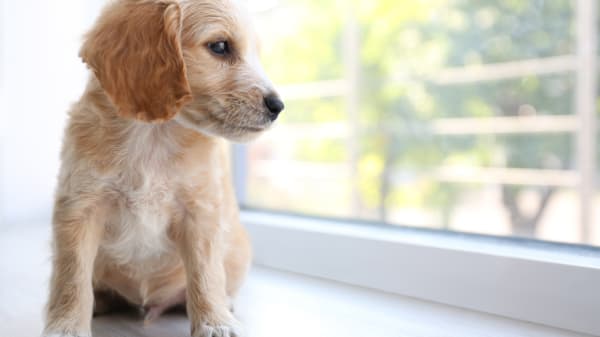
Hello, congratualtions on your new pup. Her red paw and red eye could have been something simple such as irritation from the environment or early allergies. As long as it is going away then you shouldn't need to worry about it and just continue to keep an eye on her. Monitor her for any worsening redness, loss of appetite, lethargy, and vomiting. If you note any of these, then have her seen.
Here is some further information on how to potty train your pup. Hope this helps and best of luck.
Basic Principles of Canine Elimination Behavior:
• Puppies and dogs are taught by their mothers not to soil their “dens”, and have an innate aversion to doing so.
• A puppy lacks development of the bladder muscles necessary to hold their urine and feces for long periods of time as adult dogs can.
• Breeds of dogs may vary in their responsiveness to housetraining. Even though there may be differences in breeds, the same principles of housetraining apply.
What To Do:
When you’re away from home...
• DO keep puppy in a small, confined area (e.g. dog crate, bathroom, puppy pen) and make it appealing by providing toys, food, bedding, etc. Your puppy will come to see this as his “den,” which he will prefer not to soil. If you are gone for long periods of time in which your puppy physically cannot hold its bladder, make sure that the area is large enough that the puppy can get away from the mess. An example would be an exercise pen or small room, with the area for elimination set away from its food, water, and resting areas.
• DO gradually expand the den area until the puppy can be trusted to eliminate appropriately while having access of the entire home.
• DO remember the number of hours puppies can delay their elimination is strongly linked to their age.
When you’re at home...
• DO have a schedule for taking your puppy to designated area to eliminate. For example:
• DO have a feeding schedule in which elimination breaks follow eating and drinking; this is a natural reflex in dogs. Elimination breaks should also follow napping/sleeping and exercise/play.
• DO praise your puppy at the time he is eliminating in an appropriate place! You can also give him a small treat at that time.
• DO constantly supervise puppy to prevent him from sneaking off and eliminating when you can’t correct him; try keeping him on a leash attached to your waist.
• DO clean inappropriate eliminations thoroughly with enzymatic cleaner to remove residual smells that may entice puppy to revisit the area.
Age of Puppy
Frequency of Elimination Breaks
6-14 weeks
8-10 times daily
14-20 weeks
6-8 times daily
20-30 weeks
4-6 times daily
30 weeks and older
3-4 times daily
Updated on September 24th, 2025


 Members-only pricing and offers, personalized care notifications, Vital Care points back on every purchase and more!
 Become a credit card member today!