Two Easy Ways to Start Earning Rewards!
Become a member today! Members-only pricing and offers, personalized care notifications, Vital Care points back on every purchase and more!
 Become a credit card member today!
Earn 2X Pals Rewards points at Petco
when you use Petco Pay!APPLY NOWLearn More About Petco Pay Benefits
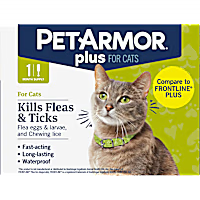
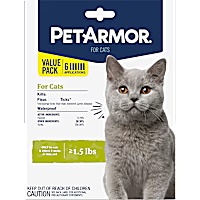
PetArmor Flea Drops for Cats
Get It Today



Related Searches
Related Articles & Questions
- New Pet
Protect Your Pet: Flea & Tick Control Solutions for Dogs & Cats
Learn how to remove flea and ticks. Petco has flea and tick removal services for dogs and cats. Get fleas and ticks removed at your neighborhood Petco.
Updated on July 28th, 2026
- Health & Wellness
Get Rid of Cat Fleas: Identify, Treat & Prevent Infestations
If you've spotted the tell-tale sign of fleas, the first thought you may have is, "How can I get rid of fleas on cats?" But, along with treatment for your pet, prevention methods are essential for their comfort and health.
Updated on October 23rd, 2025
- Health & Wellness
Fleas in Cats: Is Injectable Flea Prevention Right for Your Cat?
Because fleas are so problematic, flea prevention is essential! Commonly prescribed preventives include oral and topical medications—although injectable flea prevention is available, as well.
Updated on June 19th, 2026
- Health & Wellness
How Long After Pest Control Is It Safe for Pets?
You may have heard that flea and tick prevention are crucial for dogs and cats, but do you know why? Petco is sharing why and how to prioritize pest prevention for your pet.
Updated on June 19th, 2026
- Health & Wellness
Flea Infestation in Dogs & Cats: Symptoms, Treatment & Prevention
Read more about the different types of flea treatments and how they work to help eliminate fleas from your pet for their safety and happiness.
Updated on June 19th, 2026
- Vet Q & A
My cat still has fleas after PetArmor. Can I reapply it safely?
In order to get rid of all the fleas you will also need to vacuume your house often including upholstered furniture and carpeted and uncarpeted floors. Put flea powder in the vacuum cleaner bag and discard the bag outside in the trash. This will hopefully remove larvae which live on house dust as well as flea eggs. For every flea you see on your cat, there are at least 10 more fleas in his environment. You can reapply the petarmor in a few days. Make sure it is the preparation for cats and make sure to apply it on the skin between the shoulder blades after parting the hair. Unfortunately, there are fleas that are resistant to fipronil, which is the active ingredient of Petarmor.
Updated on September 24th, 2025
- Health & Wellness
Why are my cat's flea drops not working? How to eliminate fleas?
SIGNS OF TOXICITY All flea control products are potentially toxic or may produce unexpected side effects. Toxicity may result from accidental overdose or unexpected sensitivity. Known side effects, although rare, are vomiting, diarrhea, drooling, sluggishness, weakness, or abnormal behavior. If you suspect that your animal is reacting adversely to a flea control product, stop using the product and consult your veterinarian immediately. If the reaction occurs immediately after application, the product should be rinsed off thoroughly and the animal brought to the veterinarian for evaluation. Adverse reactions may occur from minutes to days following application. Insecticides can be toxic to people; all products should be handled carefully, avoiding direct contact as much as possible. Keep all products out of the reach of children. Cats are particularly sensitive to many pesticides. ONLY USE PRODUCTS LABELED TO BE SAFELY USED ON CATS. If you have any questions about a product’s safety, please consult your veterinarian. FLEA CONTROL IN YOUR ENVIRONMENT Immature life stages of the flea accumulate in the environment when animals with fleas serve to disperse flea eggs into the environment where they then hatch into juvenile life stages. House and yard treatments need to be concentrated on "source points", which are areas where your pets spend most of their time. This typically would include the bedding and resting areas, the feeding location, etc. You can lessen the flea burden in your home by thorough vacuuming of all source points followed by disposal of the vacuum bag and by washing all animal bedding weekly in hot water and drying at high heat for twenty minutes. Steam cleaning of rugs and carpeting +/- upholstery is also helpful. In the yard, focus on areas where your pet(s) or other animals spend most of their time. Typically, fleas survive and reproduce in shaded, moist areas with plant or organic debris (under decks, bushes, storage sheds, etc). Fleas do not survive or reproduce well in sunny, open areas of lawn or patio. Elimination of yard debris will be helpful in reducing flea numbers. You may choose to utilize a professional exterminator service for the treatment of fleas in your home and garden. REALISTIC EXPECTATIONS It is important to realize that the various anti-flea medications do not eliminate the immature forms of fleas in the environment. Thus, for the first month or so you may continue to see fleas on your pet as the juvenile forms mature and search for a new host. This does not mean that the fleas have built up resistance to the medication – in reality, flea resistance to these products is quite rare. The most common reasons for failure to control a flea problem are: 1. Frequent washing of a pet treated with a spot-on product (this includes swimming in pools, lakes or the ocean). 2. Inconsistency in the application of the product. 3. Failure to treat all pets. 4. Wildlife reservoirs of fleas (feral cats, raccoons, opossums, coyotes, etc.). Thus areas below outside decks, old sheds, etc. should be barricaded or locked to discourage such ‘visitors’.
Updated on September 24th, 2025
- Vet Q & A
My cat licked Pet Armor Plus. Is her drooling and foaming normal?
Pet Armor is the same active ingredient as Frontline. As long as you applied the correct cat product your cat should be fine. The product is very bitter and nasty tasting, that's why she drooled. To prevent this in the future, be careful to apply the product high on the back of your cat's head and neck only. Watch your cat for signs of illness just to be safe.
Updated on September 24th, 2025
- Health & Wellness
What are the best flea and tick prevention products for my cat?
Thanks for using Petco Pet Education Center, formerly Petcoach! In my opinion, the best two flea and tick preventative medications are Bravecto and Frontline plus. Any of those would be good options for him. Good luck and have a good night!
Updated on September 24th, 2025
- Vet Q & A
Need flea treatment for multiple cats? What's best to buy online?
If it is available, my best topical flea treatment for cats is Cheristin. It is very effective and kills fleas before they bite, which is helpful for cats with flea allergies since it is the bite they react to. Comfortis is a tablet that is also very effective, but it can cause vomiting.
Updated on September 24th, 2025