


Two Easy Ways to Start Earning Rewards!
Become a member today! Members-only pricing and offers, personalized care notifications, Vital Care points back on every purchase and more!
 Become a credit card member today!
Earn 2X Pals Rewards points at Petco
when you use Petco Pay!APPLY NOWLearn More About Petco Pay Benefits
Tropical Gecko Care: The Ultimate Guide to Food, Habitat & Health
Updated on October 13th, 2023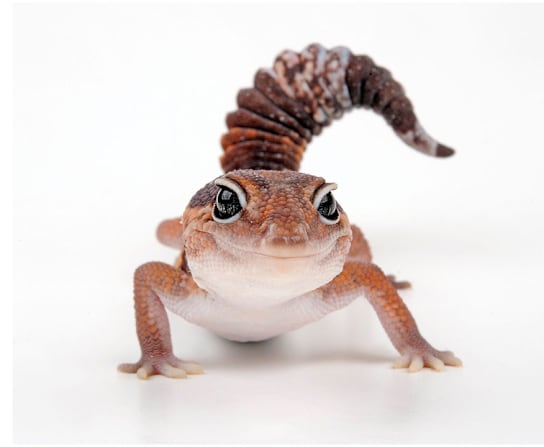
Tropical geckos are comprised of several different species who are native to different geographies and have very different appearances. The African fat-tailed gecko is a nocturnal (active at night), ground-dwelling lizard found in the deserts of West Africa. The crocodile gecko, also called the common wall gecko or Moorish gecko, is a nocturnal lizard native to rocky regions and cliffs in North Africa (including Morocco, Libya, Egypt, the Sahara and Tunisia). They are also found in France, Italy, Slovenia, Croatia, Greece and the Iberian Peninsula are are an invasive species in Spain, Uruguay, Portugal, Argentina and parts of the United States. Giant day geckos are diurnal and found in tropical rain forests in Madagascar, where it is hot and humid. Tokay geckos are nocturnal, arboreal (tree-climbing) lizards who are native to tropical rainforests and rocky areas of Southeast Asia but who also thrive in manmade environments among humans. Golden geckos are also nocturnal, arboreal lizards found in Southeast Asia and Vietnam.
Many tropical geckos are easily stressed and do not like to be handled; some may even become aggressive and bite when handled. When stressed, their normally bright skin colors become darker. Never grab geckos by their skin, or it may slough off, or grab them by the tail, as they can release their tails as part of a defense mechanism to get away from predators. Their tails often will grow back but will not resemble their original tail.
Learn how to care for tropical geckos, recommended diet & habitat setup. Find the right food, supplies & equipment at your neighborhood Petco.
Care recommendations can cover a variety of species, including:
- African fat-tailed geckos - Hemitheconyx caudicinctus
- Crocodile geckos – Tarentola mauritanica
- Giant day geckos – Phelsuma grandis
- Tokay geckos – Gekko gecko
- Golden geckos – Gekko ulikovskii
Typical appearance and behavior
African fat-tailed geckos
- These lizards have tan to brown bodies with alternating tan and brown stripes. Some have a thin white stripe down their backs
- They are one of the few species of geckos who have eyelids to help keep debris out of their eyes
- They have large heads and thick tails (hence their name)
- They are popular pets because of their docile nature and tendency to accept to being handled once they are acclimated to a habitat
Crocodile geckos
- These lizards have gray bodies and white bellies. Males have brown patterning along their backs and white marks on their shoulders, while females are all gray. Females have numerous raised projections (called tubercular scales) along their backs, while males only have these on their sides
- Both sexes have adhesive pads on their toes to help them stick to surfaces as they climb
- These lizards are arboreal and nocturnal but, as pets, tend to be active during the day, too
- They do well housed in pairs, but males should not be housed together, as they are territorial and will fight
- In general, these lizards are nervous and skittish and don’t enjoy being handled
Giant day geckos
- Giant day geckos get their name from their large size (up to 10 inches long) and thick, muscular bodies
- Their bright green coloring helps them camouflage among the leaves of tropical trees while waiting to hunt for prey
- They have red spots on their bodies and red lines from their eyes to their snouts
- They have large, dark eyes encircled by a bright blue ring
- Males are larger than females and have brighter coloring
- Immature geckos have brown bodies and yellow-brown heads
- They make several sounds, including barking, clicking and croaking sounds
- They are diurnal (active during the daytime) and prefer to rest on smooth surfaces by using broad scales (called lamellae) on the underside of their toes that help them stick to and climb vertical surfaces (or even hang upside down)
- Giant day geckos may be housed alone or in pairs. Males should not be housed with other males, as they will fight until one is injured or killed. Pairs may bond for life
Tokay geckos
- More distinctive looking than most other gecko species, tokay geckos are also typically more nervous and aggressive than other gecko species
- They are often kept as pets for their beautiful colors, despite their feisty nature and tendency to bite
- They can be good pets for experienced reptile pet parents and are better for people who want to observe, rather than handle, their pets
- Adult females may grow to 8 to 12 inches long, while adult males may reach 13 to 16 inches. Females are not as vibrantly colored as males
- These geckos are easily stressed and do not like to be handled; some become aggressive and bite when handled. If bitten, do not try to pry the gecko off, but instead set the animal down on a flat surface until the gecko relaxes and lets go.
- They have blue-gray skin with either red or black spots and large gold eyes with slit-like pupils
- Their upper and lower eyelids are fused together and transparent
- They are territorial and fight when housed with other geckos, so they are best housed alone
- They communicate with each other with a specific vocalization (that sounds like “to-kay”) to locate breeding partners and with hissing or croaking sounds for defense against predators
- They have a very strong grip because their toes have hair-like projections (called setae) on them that form molecular bonds to smooth surfaces (even vertical surfaces or upside down), enabling them to stick to these surfaces under 450 pounds of pressure
- They have the remnant of a third eye on top of their heads that helps regulate their activity in response to changes in light
Golden geckos
- Also known as Baden’s Pacific gecko, these lizards are named for the tiny gold-colored scales that cover their bodies
- Males grow to 7 to 8 inches long, while females only reach 5 to 6 inches. Males have thicker tails and a row of pores on the underside of their hind legs that females lack
- Males should not be housed with other males, and females should not be housed with other females, as same-sex pairs typically will fight
- These are quick-moving lizards with delicate skin who need to be handled gently. They are resistant to handling initially but tend to become docile and more easily handled over time
Characteristics
| Care Difficulty | Intermediate |
|---|---|
| Average Life Span | Up to 15+ years with proper care, depending on the species |
| Average Adult Size | 4-12 inches, depending on the species |
| Diet | Insectivore |
| Minimum Habitat Size | Minimum 10-gallon tank for a juvenile and 20-gallon tank for one adult |
Habitat
Habitat size
Many species of tropical geckos are territorial and are best housed individually, unless a male and a female are housed together as a breeding pair. Juveniles may be housed in 10-gallon tanks, while the minimum habitat size for a single adult is 20 gallons. Pairs thrive in 30-gallon or larger tanks. Tanks should have securely fitting screened lids to help prevent escape and allow adequate ventilation. Provide an appropriately sized and shaped habitat to accommodate normal behaviors (such as climbing) and exercise.
Most tropical geckos reach adult size in six to 18 months, depending on the species and under ideal conditions.
Building your habitat
- Décor Tropical geckos do well in habitats that mimic their native tropical environments with places to climb and hide. Provide commercially available thick branches, driftwood and large rocks for climbing and basking on; tall, dense, nontoxic live or artificial plants or pieces of cork bark for hiding behind; and hiding places such caves, hide boxes, logs or tunnels. Provide tall, dense, nontoxic live or artificial plants, branches, bamboo and vines that are sturdy enough for climbing and that have broad, smooth leaves that geckos can stick to. Artificial plants with fabric leaves are hard for geckos to adhere to and do not allow water droplets to form on them for geckos to drink. Décor should be arranged to allow geckos to hide for security. Hiding places should be established to meet the needs of the specific species; for example, a hiding place should be placed on the ground for species like African fat-tailed geckos and elevated off the habitat floor for arboreal geckos
- Humidity - Geckos come from moist, tropical habitats and require moderately high humidity to thrive, with some variation by species. Maintain 60 to 80% humidity by misting plants and other décor as needed every day. Monitor humidity with a humidity gauge. Ensure good ventilation to help prevent development of bacteria and fungus. Geckos lick water droplets off leaves and off their eyes and nose. A shallow water bowl on the floor of the habitat will also help maintain humidity as it evaporates. Too dry an environment leads to problems shedding
- Substrate - As tropical geckos are native to humid habitats, they need substrate that holds moisture. Sphagnum moss, coconut fiber and orchard bark may be used to retain moisture and increase habitat humidity. Moisture-retaining bedding may be layered over a layer of commercially available paper-based bedding. Bedding made of small particles such as sand or small bark chips is not recommended, as it can be irritating to geckos’ eyes. Also, it is indigestible, so it can lead to life-threatening gastrointestinal tract obstruction if accidentally consumed. Bedding should not get too wet, or it may stick to geckos’ feet. Moist substrate should be changed frequently to prevent mold growth
- Temperature – Temperature requirements will vary slightly by species, but in general, most tropical geckos do well with a temperature gradient that is 90 to 95°F in the basking zone with 80 to 85°F during daytime and 70 to 75°F in the cool zone and at night. Monitor temperature with at least two thermometers—one in the cool zone and the other in the hot (basking) zone. Heat may be provided by an incandescent bulb, ceramic heat bulb or under-tank heating pad. Heat sources should be attached to thermostats to regulate temperatures. Thermostats are especially important with heating pads, which can get hot and cause burns through the tank floor if not regulated properly. Hot rocks should not be used as a heat source, as they can burn reptiles. Reptiles not kept at the appropriate temperature ranges are more likely to become immunosuppressed and get sick
- Lighting - Provide full-spectrum ultraviolet (UV) lighting for 10 to 12 hours a day to expose geckos to the UVB rays they need to make vitamin D in their skin so that they can absorb dietary calcium. Change UV bulbs every six months, as their potency wanes
Cleaning your habitat
Thoroughly clean and disinfect water and food bowls daily. The habitat should be spot-cleaned daily to remove droppings and discarded food. Thoroughly clean the habitat at least once a week:
- Place the gecko in a secure habitat
- Scrub the tank and furnishings with a reptile habitat cleaner or 3% bleach solution
- Rinse the tank and all furnishings thoroughly with water, removing all traces of habitat cleaner or bleach smell
- Dry the tank and furnishings before putting the gecko back into the habitat
Feeding
A well-balanced tropical gecko diet consists of:
- A variety of insects, including gut-loaded (recently fed) crickets, roaches, mealworms, hornworms, calci-worms, superworms and waxworms. Some African fat-tailed geckos and tokay geckos will eat frozen/thawed fuzzy mice once a month
- Giant day geckos and golden geckos can also eat small amounts of fresh fruit such as mango, papaya, cantaloupe, berries, figs and pineapple. While in nature these geckos eat fruit, as pets they cannot get the broad range of nutrients from fruit as they do in their native habitats, therefore, commercially based, nutritionally complete fruit formulas are a better option for feeding pet giant day geckos. These feeding formulas are also a much healthier choice than fruit baby food, which has traditionally been offered to these geckos as pets
Things to remember when feeding your tropical gecko:
- Fresh, clean water should be available all the time
- Feed appropriately sized insects based on the gecko’s Insects should be no larger than the space between the gecko’s eyes
- Feed juveniles daily, adults every other day
- If feeding commercially available diets, feed those diets two to three times per week and insects two to three times per week
- Commercially available feeding cups can be mounted in the habitat off the floor so that geckos can eat while perched on plants, as they do in nature
- Feed them no more insects than they can consume in a 30-minute period
- Sprinkle food with calcium supplement containing vitamin D daily for juveniles and two to three times per week for adults. Sprinkle food with a multivitamin/mineral supplement once a week
Care
- Geckos regularly shed their skin; ensure the humidity of the habitat is at the appropriate level to allow proper shedding
- When geckos are shedding, mist habitat more frequently to increase humidity
Where to buy
Tropical geckos are available for purchase at your local Petco Care Center. Please call ahead to check availability.
Supplies
- Appropriately-sized habitat
- Substrate
- Sphagnum moss
- Food and water dish
- Mealworm feeder
- Hideaway place
- Climbing décor
- Plants
- Heat light
- Heat fixture
- UVB lighting and fixture
- Multivitamin supplement
- Calcium supplement with vitamin D
- Cricket keeper
- Cricket food
- Cricket quencher
- Thermometers
- Humidity gauge
- Mister
Habitat mates
- Male adult tropical geckos should be housed separately, as they can be territorial and will fight. Females and males can be housed together in similar-size, same-species pairs
- Do not house different reptile species together
Health
Signs of a healthy gecko
- Active and alert
- Clear, bright eyes with no swelling or discharge
- Full, muscular body and tail
- Supple skin with no sores, swellings or discoloration
- Droppings are firm, not runny or bloody
- Eats and passes stool regularly
- Clear nose and vent
Red flags (If you notice any of these signs, contact your veterinarian.)
- Weight loss or decreased appetite
- Discharge or bubbles from eyes, mouth or nose
- Lesions, swelling or discoloration of skin or retained shed
- Lethargy
- Sneezing, runny nose, difficulty breathing
- Weakness or paralysis of limbs
- Runny or bloody stool or lack of stool
Common health issues
| Health Issue | Symptoms or Causes | Suggested Action |
|---|---|---|
| Health IssueGastro-intestinal disease | Symptoms or CausesRunny or bloody stools, caked or smeared stool around the vent, weight loss, loss of appetite caused by bacterial, viral or parasitic infection. | Suggested ActionConsult your veterinarian. |
| Health IssueMetabolic bone disease/vitamin deficiency | Symptoms or CausesInability to absorb calcium due to insufficient UVB light or improper amounts of dietary calcium/vitamin D3. If untreated, can lead to deformed, softened or fractured bones, swollen limbs, decreased appetite, weakness and lethargy. | Suggested ActionConsult your veterinarian and provide ample UVB lighting, a balanced diet and the proper amount of calcium/vitamin supplements. |
| Health IssueRespiratory tract disease | Symptoms or CausesLabored breathing, mucus and/or bubbles in the mouth or nose; can be caused by inappropriate habitat temperature and humidity, leading to secondary bacterial, viral or fungal infection. | Suggested ActionConsult your veterinarian and ensure habitat hasi the proper temperature and humidity. |
| Health IssueSkin problems | Symptoms or CausesRedness, swelling, lesions, discoloration of skin. May be due to infection with bacteria, fungus or parasites, or to an unclean habitat or inappropriate humidity | Suggested ActionConsult your veterinarian, thoroughly clean the habitat, and ensure habitat is at the appropriate temperature and humidity. |
| Health IssueDysecdesis (problems shedding) | Symptoms or CausesRetained pieces of skin anywhere on body, especially over the eyes or around toes; caused by dry habitat or underlying disease. | Suggested ActionIncrease habitat humidity; contact your veterinarian if there is no improvement. |
Notes and resources
Ask a Pet Care Center associate about Petco's selection of products available for the care and happiness of your new pet. All products carry a 100% money-back guarantee.
Because all reptiles are potential carriers of infectious diseases such as salmonella bacteria, always wash your hands before and after handling your reptile or habitat contents to help prevent the potential spread of disease.
Pregnant women, children under the age of 5, senior citizens and people with weakened immune systems should contact their physicians before purchasing or caring for reptiles and should consider having a pet other than a reptile.
Go to the Centers for Disease Control at cdc.gov/healthypets for more information about Geckos and disease.
The information on this Care Sheet is not a substitute for veterinary care. If your pet is sick or you need additional information, please contact your veterinarian as appropriate.
Related Articles


FAQs
Tropical lizards include tropical geckos, water dragons, long-tailed grass lizards, Emerald swifts, green ameiva lizards, mountain-horned lizards and neon tree dragons.
Tropical geckos and other tropical lizards eat a variety of insects, including gut-loaded (recently fed) crickets, roaches, mealworms, hornworms, calci-worms, superworms, earthworms, butterworms, hornworms, black soldier fly larvae and waxworms. Some African fat-tailed geckos, tokay geckos and other tropical lizards will eat frozen/thawed fuzzy mice once a month. Giant day geckos and golden geckos can also eat small amounts of fresh fruit such as mango, papaya, cantaloupe, berries, figs and pineapple. While in nature, these geckos eat fruit, as pets they cannot get the broad range of nutrients from fruit as they do in their native habitats, therefore, commercially based, nutritionally complete fruit formulas are a better option for feeding pet giant day geckos. Water dragons also will eat small amounts of fruits and vegetables, including shredded leafy greens (kale, mustard greens, romaine) and squash.