Health & WellnessWhat's the best way to treat my dog's crate separation anxiety?
Hello, thank you for your question about Moose. I have provided some information from a handout on crate training, it can be tough and challenging but you are doing a great job already! Moose is likely exhibiting these behaviors because he knows you are leaving him and he is trying to do anything to get you to stay and take him from the crate.
Why should I crate train my puppy?
Crate training is a great way to limit your puppy’s access to your house while he learns appropriate behavior. It will cut down on the number of “accidents” while your puppy is learning to be housetrained, and will reduce destroying and chewing of furniture or other household items. It will give you more peace of mind and freedom to be away from home during your puppy’s growing up period. If your puppy is used to being crated it will also be easier and less stressful for him to travel, to be in a cage at the veterinarian, or to be confined for any other reason in the future. You may choose to continue to use the crate into your dog’s adulthood as his very own comfortable “room”.
Why does it work?
In the wild, dogs naturally seek out dens for sleeping quarters. Presumably this is because they are closed with only one entrance, giving the dog a sense of security. Dogs instinctively do not like to soil in their dens and will go outside to eliminate. Crating your dog is simply using his instinct not to soil in his den, and so therefore allowing you to gradually teach him that your whole house is his “den” and to only eliminate outside. Some people feel apprehensive about crating their dog, thinking that it is mean and that their dog won’t like it. However, since dogs seek out dens on their own, a crate is both natural and comforting to a puppy.
How do I choose a crate?
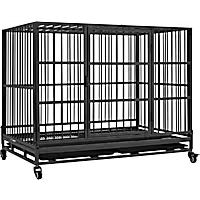
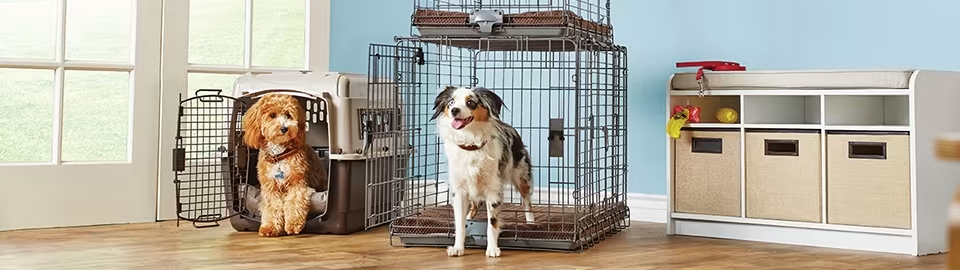
Both wire and plastic crates are available. Both work well, so it really depends on your personal preference. Keep in mind that plastic crates can be used for airline travel while wire crates may be collapsible, thus easier for storage. Getting the right size is very important. Your dog should be able to stand up and turn around freely in his crate, but it should not be big enough for him to have a separate toilet area. If your puppy is going to grow a lot more, get a crate that will be big enough for him as an adult, but block the back area so it is not big enough for him to have a separate toilet area now.
How do I crate train my puppy?
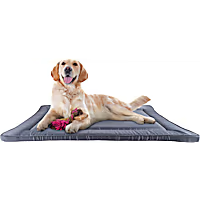
First, make sure the crate is comfortable by placing a towel or bed inside. Place the crate in a common area and put toys and treats inside for your puppy to discover. Don’t ever force your puppy into the crate, as going in should always be a positive experience. Praise him every time that he goes into the kennel. After he is comfortable going inside his crate for treats, beginning feeding his meals inside the crate. Start closing door while he is eating, but open it before he is done. Next, leave the door closed for longer increments of time, building slowly. Never open door when he is whining or scratching, but only open it when he is quiet. If he is consistently whining, he is being closed in for too long, so go back to an amount of time he tolerates well and increase more slowly. After that, start crating him at other times besides his meals. Always give him an incentive to go into the crate (treats, food-filled toys, such as a Kong®, toy etc.). First stay in the room with him and then start leaving the room for short increments of time, building very slowly. Once he handles this well you can start leaving the house for short periods of time, again slowly increasing length of time. The length of time it takes for a puppy to learn varies from dog to dog, so remember that patience is key for your puppy’s success!
Updated on September 24th, 2025


 Members-only pricing and offers, personalized care notifications, Vital Care points back on every purchase and more!
 Become a credit card member today!