Two Easy Ways to Start Earning Rewards!
Become a member today! Members-only pricing and offers, personalized care notifications, Vital Care points back on every purchase and more!
 Become a credit card member today!
Earn 2X Pals Rewards points at Petco
when you use Petco Pay!APPLY NOWLearn More About Petco Pay Benefits
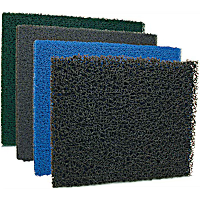
Lifegard Aquatics Saltwater Filters & Media


Related Articles & Questions
- Home & Habitat
Aquarium Salt in Freshwater Fish Tanks: Full Guide
Learn how to use aquarium salt in freshwater aquariums to promote healthy gill functions, reduce stress, and treat infections in fish.
Updated on July 17th, 2026
- Care Sheets
Aquarium Water Quality: Master Healthy Fish & Crystal Clear Tanks
Learn how to test your aquarium water. Poor water quality stresses fish, which leaves them susceptible to disease and possibly death.
Updated on October 23rd, 2025
- Home & Habitat
CO2 for Fish Aquariums: What Every Pet Parent Should Know
Wondering why you may need CO2 in your fish aquarium? Learn the basics from a Petco aquatics specialist.
Updated on July 17th, 2026
- Care Sheets
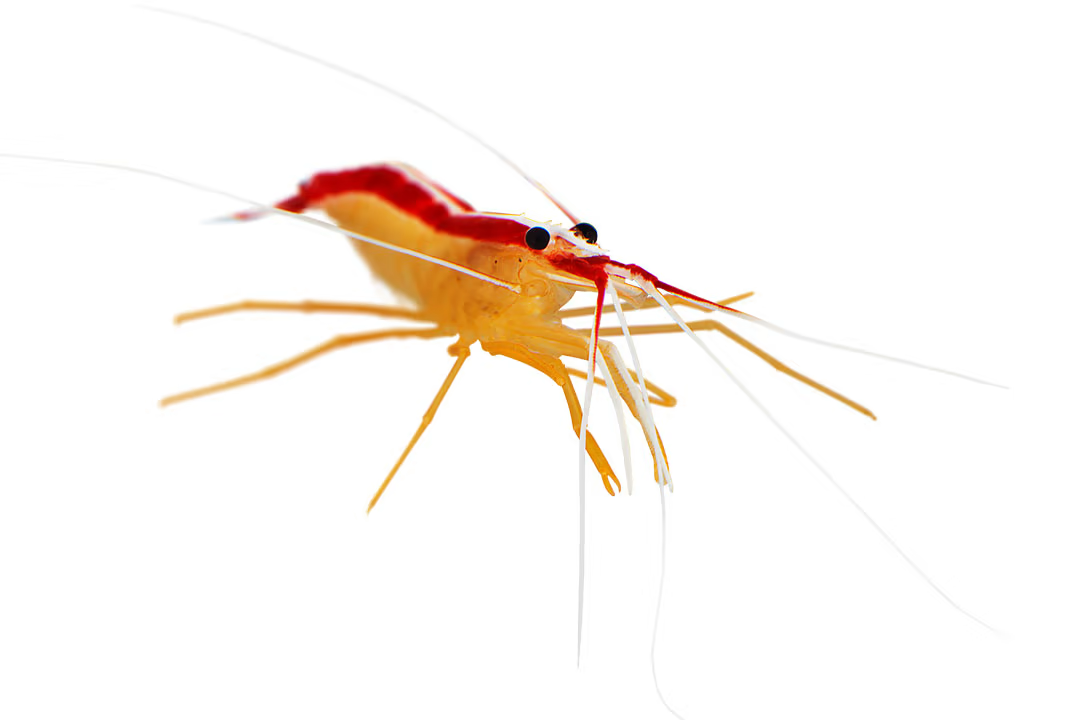
Marine Shrimp Care for Beginners: Tank Setup, Food, & Compatibility
Learn how to care for Marine Shrimp, recommended diet & aquarium setup. Find the right food, supplies & equipment at your neighborhood Petco.
Updated on April 9th, 2026
- Health & Wellness
High Nitrates in Your Freshwater Fish Tank? Protect Fish & Prevent Deaths
Search Petco to find out the harm of high nitrates in freshwater fish aquariums. We provide vital information to help keep your fish happy & healthy.
Updated on June 19th, 2026
- Vet Q & A
First fish tank: What Tetras and supplies for my 12-inch tank?
Before you buy any fish, you will need to set up the tank. A basic set up includes: a tank, filter, hood/light, heater, gravel and some decor. The tank should run without fish for at least 4 to 6 weeks. This gives it time to cycle. The Nitrogen Cycle is critical to the health of the tank and any fish you will be keeping. During this time, beneficial bacterial will populate the filter and substrate (gravel). These bacteria will be responsible for breaking down fish wastes and other wastes (uneaten food, dead plants, etc.). You will need a home test kit to monitor water chemistry (ammonia, nitrites, nitrates, pH) or you will have to submit water samples for testing. Most pet stores will do this for free or for a small fee. At first, you will see high levels of ammonia and nitrites. Over time, as bacteria grow, these levels will drop. When ammonia and nitrites are at 0 ppm and nitrates are below 20 ppm, you can consider adding fish. Regular (every 1 or 2 weeks) partial water changes as well as filter changes will be needed to maintain stable water chemistry and adequate water quality. The size of your tank will determine what fish and how many you will be able to keep. Most Tetras do best in groups, so a 12 inch tank may not be large enough. There are several article in the Petco Pet Education Center, formerly Petcoach Library that will provide more detailed information. Click on "Educational Center" at the top of the page, then scroll down to "Articles" and click. Use the Search Bar to find articles regarding aquarium set up and fish keeping.
Updated on September 24th, 2025
- Vet Q & A
What saltwater fish can I safely keep in a 10 gallon tank?
Thanks for reaching out, the rule of thumb is 1" of fish per 3 gallons, but smaller tanks are very difficult to keep stable, and saltwater fish are easily stressed by environmental fluctuations (salinity, temperature, dissolved oxygen). Good luck.
Updated on September 24th, 2025
- Vet Q & A
How to save my sick freshwater fish after an ammonia spike?
Monitor water chemistry using a home test kit or submit a water sample for testing. The local Petco may do this for free or for a small fee. Aim for an absence (0 ppm) of ammonia and nitrites with nitrates at 20ppm or less. Perform partial water changes to stabilize chemistry and/or to improve water quality. Use only conditioned water that is temperature matched to prevent stress or shock. Pristine water quality is the foundation for healing and recovery from infection or injury in fish. You can use plain aquarium salt (NOT table or Epsom salt) as a general tonic to reduce stress, improve gill function and aid in recovery. Dissolve 1 teaspoon of salt per gallon of water in a cup or two of water and gently pour it into the tank. Treat for 14 days then reassess the condition. An "all in one" product, such as Lifeguard (by Tetra), can be used concurrently to treat infection or parasites. Find one in the aquarium section of the local Petco. Follow label directions carefully and remove the carbon filter insert during treatment if indicated.
Updated on September 24th, 2025
- Health & Wellness
How to treat dirty tap water with iron for a healthy aquarium?
Some iron is necessary for a healthy aquarium, but too much can promote algae growth or impart an unsightly yellow or orange tinge to the water. Reverse osmosis (RO) filters are deal for removing mineral and heavy metals from water but they can be prohibitively expensive. Buying RO water from a local market or pet store is also a possibility but not economically feasible if you have a large tank. The best option may be a Polyfilter, which can be purchased in the local pet store or online. These filters will remove iron or other metals/chemicals and must be changed monthly or quarterly. You can also buy a water conditioner that will precipitate out some of the iron which can then be removed by mechanical filtration. An example of just one is Rid Metals (by Kordon). Follow label directions carefully, perform regular water changes and monitor iron levels with a home test kit or by submitting a water sample for testing.
Updated on September 24th, 2025
- Food & Nutrition
Is my 5.5-gallon tank filter too strong for a new baby betta fish?
If you can adjust the filter flow, it should be fine if you turn it down. If not, you may need to use something to redirect the outflow to decrease current strength. You can use a piece of sponge or pre-filter in the intake to prevent a small fish from being drawn into the filter. Although live food is nice, it can be difficult or time consuming. Live food can be purchased online and typically includes instructions on care and feeding. Food companies all offer "micro-pellets" for smaller fish which is also an option.
Updated on September 24th, 2025